BTS Part 2 — How Seven Boys Moved the World: The Rise
From a struggling Seoul label to the world's biggest stages — the complete story of how BTS broke every barrier in global music, milestone by milestone.
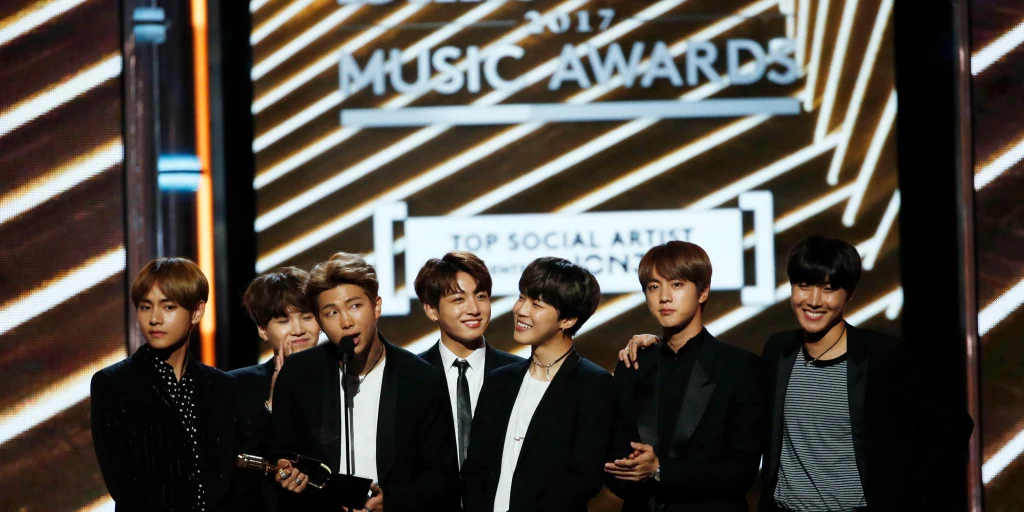
In May 2017, BTS walked onto the stage at the Billboard Music Awards.
Justin Bieber had won the Top Social Artist award for six years in a row. Nobody seriously expected that to change.
BTS won it.
The arena erupted — screams, fans shrieking with disbelief. A K-pop group — one that barely anyone in mainstream America had heard of a year earlier — had just outpolled Justin Bieber, Selena Gomez, Ariana Grande, and Shawn Mendes combined.
That was the moment the world started paying attention.
But the story of how they got there started years earlier, in a cramped practice room in Seoul, with a group of teenagers who were told they’d never make it.
K-Unpacked’s take: Before BTS, “K-pop breaking through in America” almost always meant one song, one moment — PSY’s “Gangnam Style” is the obvious case: a genuine phenomenon, but one built around a single viral clip rather than an ongoing relationship with an audience. What actually made BTS’s rise structurally different, and much harder for another act to simply replicate, is that almost none of the milestones below are about one song going viral. They stack: a Twitter presence built years before anyone in the US industry was paying attention, a fandom infrastructure (ARMY) that had already learned to organize and vote as a bloc before the BBMA win, and a catalogue deep enough that a first-time listener in 2017 had four years of material to fall into instead of one clip to rewatch. Virality gets you a week of attention. What BTS built gets you seven straight years of milestones that compound on each other.
📌 This is Part 2 of a 3-part BTS series.
- Part 1 — Seven Strangers, One Stage ← where it began
- Part 2 — How Seven Boys Moved the World ← you are here
- Part 3 — The Empire That Never Sleeps
Phase 1: The Struggling Years (2013–2014)
A Debut Nobody Noticed
BTS released 2 Cool 4 Skool on June 12, 2013, and made their official music-show debut with “No More Dream” the following day — a track that told Korean teenagers to stop letting society crush their dreams. It was honest, it was angry, and it was aimed directly at young people who felt trapped by a system built around academic pressure and conformity.
It didn’t chart high. It didn’t go viral. But it found its people — quietly, slowly, through online communities where Korean teenagers shared music they actually felt.
BTS won Best New Artist at the 2013 Melon Music Awards, with additional rookie awards following at major ceremonies in early 2014. These were real accomplishments for a group from a small label. But the industry wasn’t watching closely yet.
Building the Bond Before the Breakthrough
What Big Hit did differently in these early years mattered: they opened the door between BTS and their fans.
Big Hit and BTS used Twitter, YouTube, SoundCloud, and video logs unusually consistently for a rookie K-pop group, allowing international fans to follow the members closely well before they received any broad Western media exposure. The members appeared unfiltered — tired, funny, frustrated, grateful, human.
ARMY started forming not around a polished image, but around seven real people they felt they actually knew.
📍 Milestone: First US Concert (2014)
In 2014, BTS held Show & Prove at the Troubadour in Los Angeles — their first concert in the United States. (They had already held their first overseas showcases in Tokyo the previous December.) The LA venue was small. The crowd was small. But the fans who showed up had found BTS largely through the internet.
That was a signal. Something was building outside Korea that the charts couldn’t yet measure.
Phase 2: The Breakthrough Era (2015–2016)
 The moment BTS stopped being a cult following and started being a movement.
The HYYH Era: Youth, Pain, and Poetry
In 2015, BTS released The Most Beautiful Moment in Life, Pt. 1 — the start of what fans call the HYYH era (화양연화, The Most Beautiful Moment in Life).
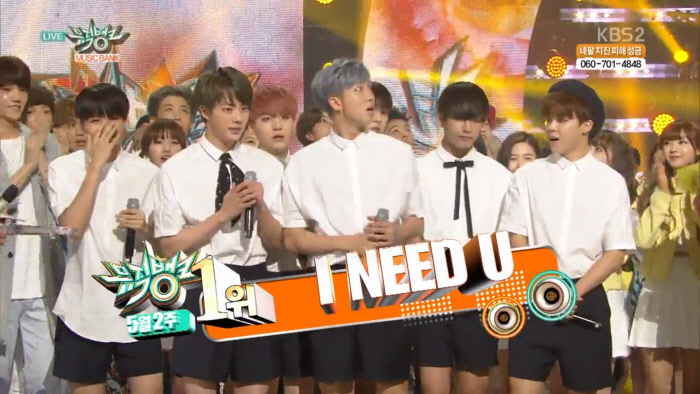
The music shifted. It became more cinematic, more emotional, more layered. Songs like “I Need U” and “Run” explored unstable relationships, emotional pain, and the vulnerability of youth. The HYYH music videos and prologue clips introduced a connected visual narrative — one that expanded further with the individual short films released ahead of Wings, giving fans a growing world to analyze and debate.
📍 Milestone: First Music Show Win (2015)
“I Need U” won on The Show — a Korean weekly music broadcast. It was BTS’s first #1 on a music program. In K-pop, this matters enormously. It meant they were no longer just underdogs. They were contenders.
📍 Milestone: First Billboard 200 Entry (2015)
The Most Beautiful Moment in Life, Pt. 2 debuted on the Billboard 200 at #171. For a K-pop group releasing music primarily in Korean, getting on the chart at all was news. It suggested there was a real Western audience forming.
📍 Milestone: Wings — Korea’s Best-Selling Album of the Year (2016)
In October 2016, BTS released Wings.
It became South Korea’s best-selling album of 2016, with roughly 751,000 copies sold domestically that year — a new record on the Gaon Chart at the time. The album topped the iTunes albums chart in 23 countries and entered the Billboard 200 at #26 — at the time, the best US chart position ever for a K-pop album. (By 2020, cumulative sales of Wings alone surpassed 1 million copies, with the Wings/You Never Walk Alone pairing exceeding 1.8 million combined.)
More importantly: the album was ambitious. Musically and lyrically, it drew from literature (Hermann Hesse’s Demian) and explored the tension between innocence and corruption, youth and temptation. It wasn’t what people expected from a K-pop group.
Critics noticed. Serious music publications started paying attention.
Phase 3: America Opens the Door (2017)
The BBMA Win That Changed Everything
On May 21, 2017, BTS won the Top Social Artist award at the Billboard Music Awards — ending Justin Bieber’s six-year streak.
The win was driven by ARMY’s votes. It was the first time most people in the American music industry had heard the name “ARMY” used to describe a fandom. They were organized, passionate, and enormous. And they had just shown up in American media in the most visible way possible.
📍 Milestone: American Music Awards Performance (November 2017)
On November 19, 2017, BTS performed “DNA” at the American Music Awards.
It was the first time a K-pop group had performed at a major American awards show. (PSY had performed as a solo act at the 2012 AMAs, alongside MC Hammer.) The performance featured tight choreography and drew massive attention from American audiences who had never heard of BTS, many of whom watched millions of the group’s fans react online.
The clip spread rapidly across social media, and interest in anything BTS-related surged.
📍 Milestone: “Mic Drop” Remix — Into the US Top 40
In December 2017, the Steve Aoki remix of “Mic Drop” debuted at #28 on the Billboard Hot 100 — making it the first song by a K-pop group to enter the chart’s Top 40. (PSY’s “Gangnam Style” and “Gentleman” had already reached the Hot 100 Top 40 as a solo artist years earlier.)
Radio stations that had never played Korean-language music started getting requests. Something that had seemed structurally difficult — a Korean-language song reaching mainstream American radio attention — was now a reality.
📍 Milestone: UNICEF “Love Myself” Campaign (November 2017)
BTS partnered with UNICEF to launch the Love Myself campaign against violence toward children and youth. By March 2024, BTS, their label, and supporters had contributed a combined total of roughly $6.6 million through the campaign.
For a pop group to use their platform this seriously — not just with a tweet, but with a multi-year funded initiative — was genuinely rare. It established BTS as something different from a typical music act.
Phase 4: The Global Summit (2018)
Love Yourself: Tear — Billboard 200 #1
In May 2018, Love Yourself: Tear debuted at #1 on the Billboard 200 — the first K-pop album ever to reach the top of America’s most prestigious album chart.
The album earned roughly 135,000 equivalent album units in the US that week — a figure combining traditional sales with streaming — and it outranked every other album on the chart that week, in Korean.
That was a structural fact nobody in the music industry could dismiss.
📍 Milestone: UN Speech — “Speak Yourself” (September 2018)
On September 24, 2018, during the 73rd UN General Assembly week, RM addressed world leaders at the UN headquarters launch of UNICEF’s Generation Unlimited initiative.
RM spoke on behalf of the group in a speech about self-acceptance, pressure, and not giving up. His words — “No matter who you are, where you’re from, what your skin color is, what your gender identity is — speak yourself” — became a rallying cry for a generation.
The hashtag #BTSxUnitedNations trended worldwide within minutes.
It was a rare moment for a K-pop group to be given a platform at the UN. They wouldn’t be the last time BTS stood at that podium.
📍 Milestone: TIME Magazine — “Next Generation Leaders” (2018)
BTS appeared on the cover of TIME magazine, named among the world’s Next Generation Leaders. In the same year, they became the youngest recipients ever to receive South Korea’s Order of Cultural Merit.
Phase 5: Stadium-Level and Beyond (2019–2020)
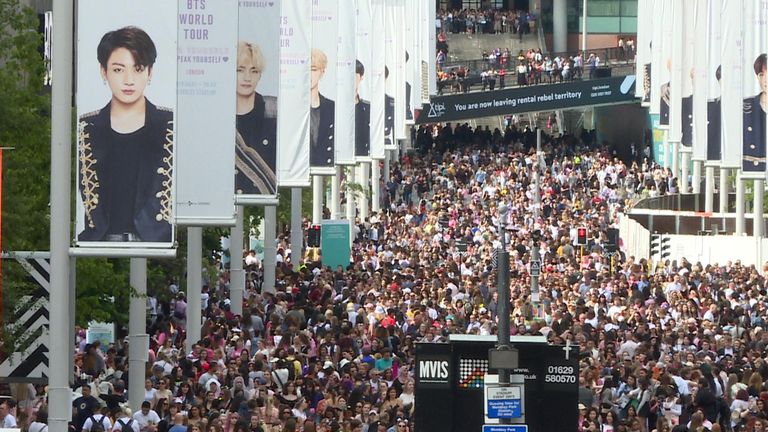 Wembley. The Rose Bowl. Sold out. For a group from a small Seoul label.
📍 Milestone: Wembley and Rose Bowl (2019)
The Love Yourself World Tour brought BTS to:
- Wembley Stadium, London — two consecutive sold-out nights in June 2019. The first South Korean group to headline and sell out Wembley Stadium; tickets reportedly sold out in around 90 minutes.
- The Rose Bowl, Pasadena — two sold-out shows, drawing roughly 113,000 combined attendees. The first Korean act to sell out the Rose Bowl.
Across these four stadium concerts — two at Wembley, two at the Rose Bowl — combined attendance exceeded 200,000. Stadium-level. Global.
📍 Milestone: Grammy Stage Appearance (January 2020)
On January 26, 2020, BTS became the first Korean act to perform on the Grammy stage, joining Lil Nas X and other artists in a medley performance of “Old Town Road” at the 62nd Grammy Awards.
📍 Milestone: “Dynamite” — Billboard Hot 100 #1 (August 2020)
On August 31, 2020, BTS made history.
“Dynamite” — their first fully English-language single — debuted at #1 on the Billboard Hot 100. They became the first Korean act to top the chart that had defined American pop music since 1958.
Released during the COVID-19 pandemic, the upbeat single was deliberately presented as a source of energy and encouragement at a moment when live concerts and much of ordinary life had come to a stop.
The ARMY Effect in Numbers
By 2020, the scale of ARMY was unlike anything the music industry had seen for a single fandom:
| Platform | ARMY’s Record |
|---|---|
| Among the most-discussed accounts globally in 2017 and 2018; most-tweeted-about musician in 2019 | |
| YouTube | Set successive records for most-viewed music video in 24 hours between 2018 (“Idol”) and 2021 (“Butter”) |
| Billboard | First act to top the Social 50 chart for 200 consecutive weeks (October 2020) |
ARMY didn’t just listen to BTS. They organized. They showed up.
What Made the Rise Possible?
Looking at 2013 to 2020, the trajectory seems almost impossible. From a small company with no budget to the #1 song in America — in seven years, in a non-English language, in a genre the Western music industry had dismissed for decades.
How?
① The music was real. BTS wrote about things teenagers globally actually felt — academic pressure, identity crisis, the fear of being ordinary. It wasn’t manufactured uplift. It was specific, honest, and emotionally true.
② The relationship with fans was different. ARMY didn’t feel like they were watching a product. They felt like they were watching people. The behind-the-scenes access and social media presence helped build a bond of loyalty that traditional marketing alone rarely achieves.
③ They were always growing. Each era pushed further musically, visually, and lyrically — with contributions from the members alongside producers like Pdogg, Slow Rabbit, and Bang Si-hyuk himself. Fans who loved No More Dream had no idea Wings was coming — and when it arrived, they stayed.
④ The timing of social media. BTS built ARMY just as Twitter, YouTube, and streaming platforms were becoming dominant forces in music. ARMY became unusually effective at using these platforms to organize and amplify support — arguably faster than the wider industry adapted.
🇰🇷 What This Rise Meant Inside Korea, Not Just Outside It
For international fans, BTS’s climb from a small label to the Billboard Hot 100 #1 spot reads as an underdog story. Inside Korea, it carried an extra layer: national pride mixed with real institutional recognition.
When BTS received South Korea’s Order of Cultural Merit in 2018 — the youngest recipients ever — it wasn’t a music-industry award. It’s a government honor, the same category used to recognize major contributions to Korean culture broadly, and giving it to a pop group in their twenties was a genuinely unusual move that Korean news covered as a national moment, not just an entertainment story.
The UN speech landed the same way. Korean media covered RM’s “Speak Yourself” address less as a celebrity appearance and more as a Korean citizen representing the country on one of the world’s most visible stages — the kind of framing usually reserved for Olympic athletes or diplomats, not musicians.
That national-pride framing is also exactly why the members’ mandatory military service (covered in Part 1) became such a genuinely debated public policy question in Korea, rather than just a fandom disappointment — lawmakers publicly discussed possible exemptions specifically because BTS’s achievements were seen as a matter of national interest, not just personal career success. In the end, the members enlisted on the standard timeline. But the fact that the debate happened at the National Assembly level tells you how differently Korea was watching this rise compared to a fan simply streaming “Dynamite” from abroad.
🔗 Continue the Story
- 👉 Part 1 — Seven Strangers, One Stage — The casting stories and debut
- 👉 Part 3 — The Empire That Never Sleeps — Billboard domination, World Cups, and the 2026 return