Squid Game Season 1: The Show That Broke Netflix — Spoiler-Free Guide
Number 1 in 94 countries at the same time. The most-watched show in Netflix history. Here is everything you need to know before watching Squid Game Season 1.
👉 This is Part 1 of a 2-part series on Squid Game Season 1.
📊 The Numbers First
| Record | Number |
|---|---|
| Release date | September 17, 2021 |
| Households in first 28 days | 142 million |
| Countries at #1 | 94 |
| Hours watched in first 28 days | 1,650,450,000 hrs |
| Netflix all-time ranking | 🏆 #1 TV series of all time |
| Emmy Awards | First non-English show to win Outstanding Drama Director & Lead Actor |
| Prize money in the show | ₩45.6 billion (~$38 million USD) |
In September 2021, one Korean drama landed on Netflix.
It stopped the world.
🎮 What Is Squid Game?
The idea is simple.
People who need money come together. 456 of them. All of them are in debt or desperate.
They are invited to play games. Children’s games. Games everyone played as a kid. Red Light, Green Light. Honeycomb candy. Marbles. Tug of war.
But there is one difference.
If you lose, you die.
If you win? You take home ₩45.6 billion Korean won — about $38 million.
That is the whole premise. That one simple idea swallowed the entire world.
🎬 ▶ Watch the Official Squid Game Season 1 Trailer on YouTube
🏠 What You Need to Know First
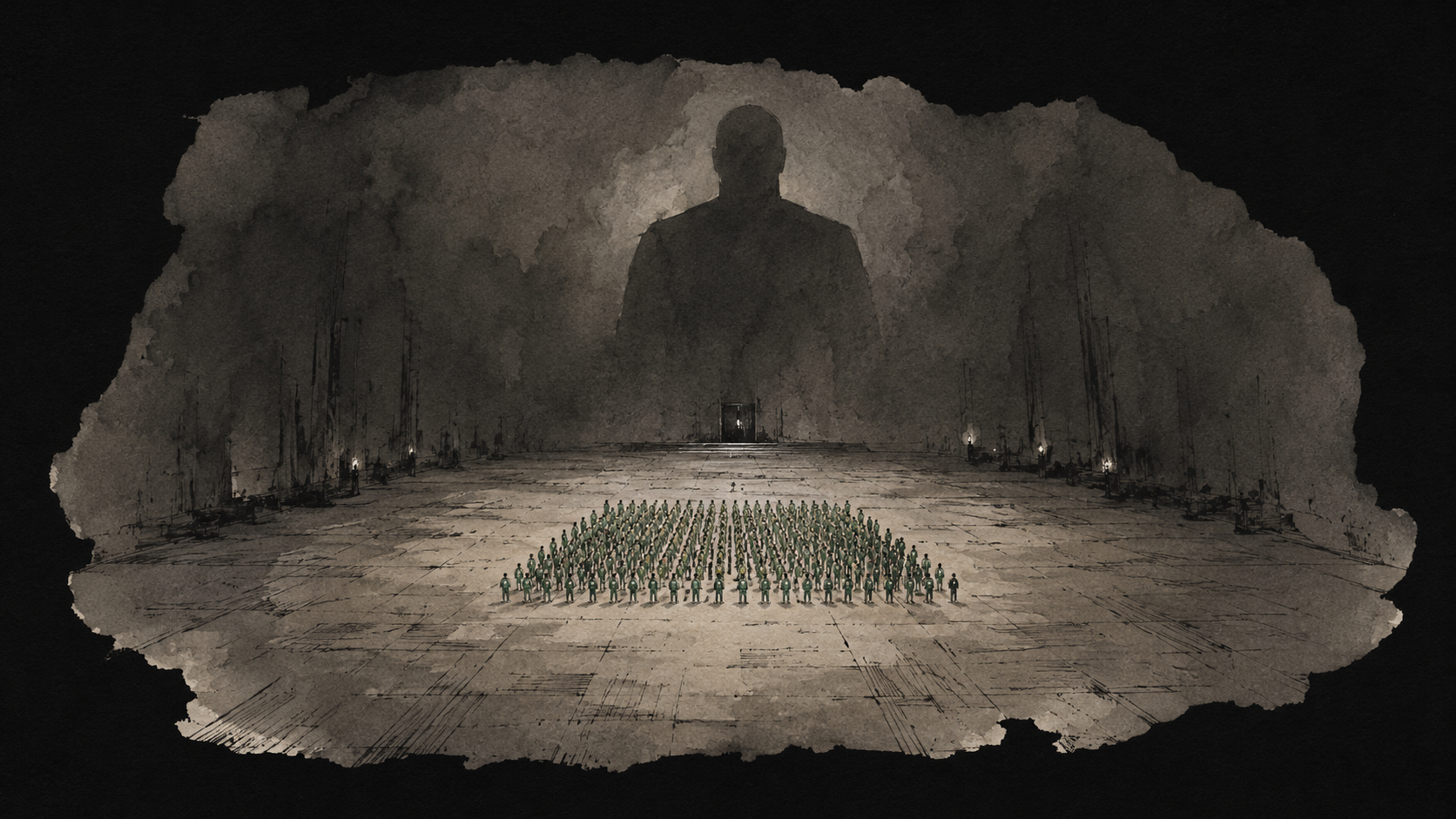
 456 players in green tracksuits — the iconic look of Squid Game
Korea’s Debt Problem
The 456 players all have one thing in common: they need money badly.
This is not fantasy. It is real.
South Korea entered the 2010s with high and rising household debt, while lower-income borrowers faced growing financial vulnerability. Many working-class Koreans found themselves trapped — paying interest on interest, with no way out.
Director Hwang Dong-hyuk has said he conceived this story during a period of serious personal financial difficulty — spending time in comic-book cafés reading survival manga like Liar Game, Kaiji, and Battle Royale, experiences that helped shape the idea. That personal background became the emotional core of this show.
○△□ — What Do the Shapes Mean?
The circle, triangle, and square appear everywhere in Squid Game — on the guards’ masks, on the Dalgona cookies, on the invitation cards.
Creator Hwang Dong-hyuk explained their origin directly: “Those are actually the shapes that first came to mind when I first conceived the idea… because I was quite literally thinking of myself as a kid… and the circle, triangle, square is exactly what you draw on the ground” when playing the traditional squid game.
The shapes also carry a social meaning. Hwang has said they “represent the limitless competition in late capitalism.” Within the show, they establish a strict rank hierarchy among the masked staff:
- ○ Circle = Worker (lowest rank)
- △ Triangle = Soldier (armed guard)
- □ Square = Manager (in charge)
Korean Children’s Games
The games in this show come from real Korean childhood. Red Light, Green Light. Honeycomb. Marbles. Tug of war.
For international audiences, these games were new and fascinating.
For Korean audiences over 40, they were childhood memories. Playing on street corners after school. Buying honeycomb candy from street vendors for a few coins.
That familiarity — the warmth of childhood placed on top of brutal death — is the central emotional shock of the show.
🎬 The Story (No Spoilers)
Seong Gi-hun (Lee Jung-jae) lives in Seoul. He is divorced. He is in debt. He gambles. He cannot take care of his daughter.
One day, a man in a suit finds him at a subway station. He challenges Gi-hun to a card-slapping game. Win, you get money. Lose, you get slapped. Gi-hun wins.
The man gives him a business card with a phone number.
Gi-hun calls.
He is taken to a game. He finds out — too late — that losing does not mean going home. It means dying.
456 players. Six games. One survivor takes all.
👥 Main Characters
| Number | Name | Actor | Who Are They? |
|---|---|---|---|
| 456 | Seong Gi-hun | Lee Jung-jae | Main character · ex-auto worker · gambling addict |
| 218 | Cho Sang-woo | Park Hae-soo | Gi-hun’s childhood friend · Seoul National University graduate · facing serious financial and legal trouble |
| 067 | Kang Sae-byeok | Jung Ho-yeon | North Korean defector · fighting for her family |
| 001 | Oh Il-nam | Oh Yeong-su | Player #1 · elderly man · mysterious presence |
| 101 | Jang Deok-su | Heo Sung-tae | Gang boss · will do anything to survive |
| 199 | Ali Abdul | Anupam Tripathi | Pakistani migrant worker · kind and trusting |
| 212 | Han Mi-nyeo | Kim Joo-ryung | Loud and resourceful player · the show’s most unpredictable wild card |
| 240 | Ji-yeong | Lee Yoo-mi | Sae-byeok’s partner · carries a quiet secret |
📋 Quick Facts
| Title | 오징어 게임 — Squid Game Season 1 |
| Release | September 17, 2021 |
| Episodes | 9 |
| Director & Writer | Hwang Dong-hyuk |
| Budget | ~$21.4 million USD |
| Estimated Netflix “impact value” | ~$891 million USD (Bloomberg estimate, based on internal Netflix metric) |
| Emmy Awards | Non-English drama: first ever Director + Lead Actor wins |
🌍 Who Should Watch This?
This show is for you if you want:
- A short, intense story (9 episodes — easy to finish in a weekend)
- Survival drama with real emotional weight
- Social commentary wrapped inside an action story
- To finally understand what everyone was talking about in 2021
One warning: the show is violent. It earns its mature rating.
But the reason people could not stop watching was not the violence. It was the characters. You care about these people. That is what makes every death hurt.
🌍 A Survival Thriller Abroad, a Mirror at Home
For a lot of international viewers, Squid Game landed first and foremost as a brutal, brilliant genre thriller — the kind of show you describe to friends by its premise (children’s games, except you die) before you get to what it’s actually about.
Korean viewers tended to read the class commentary faster and more literally. Household debt, predatory private lending, and the shame around financial failure are subjects that show up constantly in Korean news and everyday conversation — not abstract themes, but a lived backdrop for a lot of people watching. When Gi-hun’s economic desperation gets treated by the show as something almost anyone could fall into, that landed for many Korean viewers less like a dramatic premise and more like a recognizable, close-to-home worst-case scenario.
Neither audience is watching a “wrong” version of the show. But it’s worth knowing that a story built specifically around one country’s debt crisis and social pressure became one of the most universally understood shows in television history — proof that a very specific, very Korean anxiety translated into something the whole world recognized as its own.
🔗 Read More
- Part 2 — Every Game Analyzed, Full Spoiler Deep Dive & Cast Profiles →
- 10 Korean Dramas That Became Global Netflix Phenomena →
- Parasite — The Korean Film That Won the Oscars →
- See all K-Drama posts →
Data: Netflix official engagement reports · Emmy Awards official · Wikipedia