Extraordinary Attorney Woo (Part 2): The Ending, the Whale, and the Mother Who Left
A full spoiler deep dive into Extraordinary Attorney Woo: the hackberry tree case, Tae Soo-mi's secret, Kwon Min-woo's arc, the whale symbolism, and the finale.
⚠️ Full spoilers. This post discusses the ending of Extraordinary Attorney Woo in detail, including the identity of Young-woo’s biological mother. If you have not finished the show, start with our spoiler-free Part 1 instead.
Why This Show Rewards a Second Look
Part 1 was the pitch. This is the part where we take the show apart.
Extraordinary Attorney Woo looks like a simple case-of-the-week legal drama. Underneath, it is running two much bigger stories at the same time: one about a 500-year-old tree, and one about a mother who gave up her daughter and spent decades pretending she didn’t.
Let’s start with the tree, because it turns out to be real.
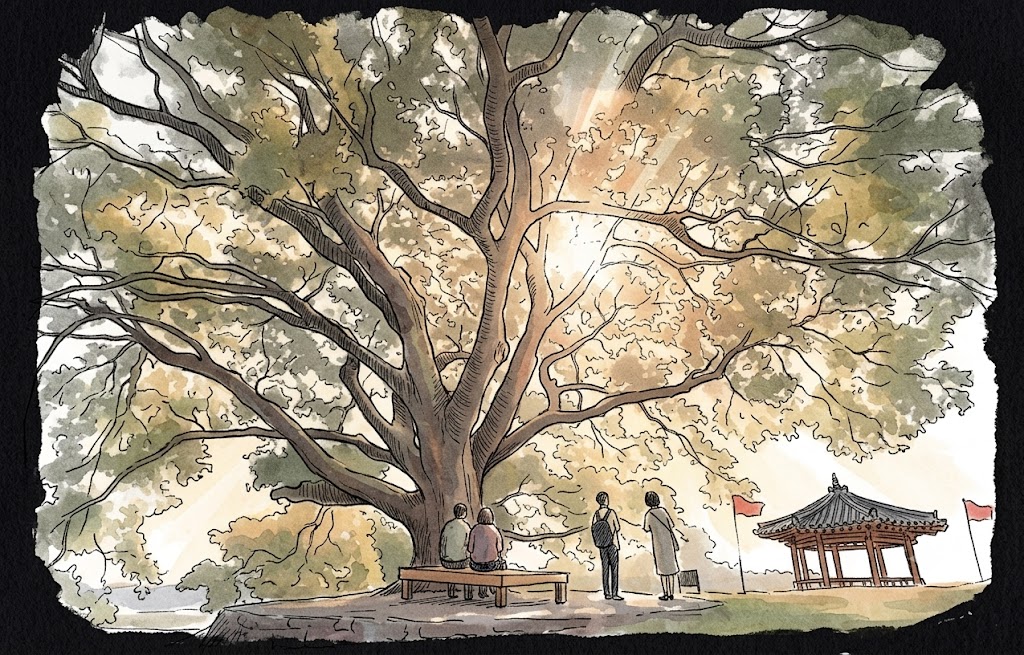
The Hackberry Tree Case, and the Real Tree Behind It
Episodes 7 and 8 center on the fictional village of Sodeok-dong, where Gyeonghae Province wants to build a road straight through the village to reach a new development. The road would split the town in half, and it would also mean cutting down an ancient hackberry tree the village has treated as its guardian for generations. Taesan, the rival law firm, represents the province defending the road plan. Hanbada represents the villagers suing to have the road route thrown out.
The provincial side plays it smart. It offers residents a compensation package roughly double what they’d get otherwise, and Taesan uses that offer to peel away support before Hanbada can organize the village’s opposition. It works — enough households sign consent forms that Hanbada looks likely to lose outright.
Young-woo finds the crack almost by accident. During a rainy site inspection, she notices the presiding judge’s umbrella carries a dolphin logo — the branding of Kyungpyo Construction, a company handing out umbrellas at model homes for a planned new town in the same area. It’s not proof of anything on its own, but paired with a separate discovery — that a corrupt provincial official had been secretly stalling the tree’s natural-monument application for years — it’s enough. Hanbada files a motion challenging the court’s impartiality over the umbrella, and, more decisively, forces the tree’s suppressed application back into motion. By the end of the episode, the hackberry tree is confirmed a natural monument, which blocks the original road route regardless of how the disqualification motion plays out.
Here’s the detail that makes this case different from every other one in the show: the tree is a real tree, and the drama’s own name for it is real too.
The tree that stood in for Sodeok-dong’s hackberry is the actual hackberry in Bukbu-ri, Changwon — roughly 500 years old, 16 meters tall. After the episode aired, visitors started showing up in numbers large enough to strain the village’s parking and create a litter problem. Korea’s Cultural Heritage Administration (now the Korea Heritage Service) opened a formal review of the tree’s value. On September 29, 2022, the committee voted to designate it; the designation was officially gazetted on October 7, 2022, under the name “East Asian Hackberry of Bukbu-ri, Changwon.” The agency’s own citation credits the tree’s roughly 500-year age, a documented history stretching back to a 1934 newspaper account of a flood, its role in the village’s Dangsanje rituals, and the scenic overlook from the hill where it stands. The show’s popularity is what got the review started — but the designation itself rests on the tree’s own, independently verified history.
If you enjoyed how Goblin treated old, half-forgotten places as sites of quiet meaning, this case is doing something similar, just with a courtroom instead of a folk tale.
The Mother Question: Tae Soo-mi
Now for the story running underneath almost everything else.
Tae Soo-mi, the sharp, ambitious attorney who runs rival firm Taesan, is Woo Young-woo’s biological mother.
The backstory, filled in across the show: young Tae Soo-mi and Woo Gwang-ho were dating in college when she got pregnant. She didn’t want to be a mother — she had a career to protect. Gwang-ho begged her, on his knees, to let the baby live: he would raise the child alone and disappear from her life entirely afterward. She agreed. Young-woo was raised by her father alone, without a mother, for the rest of her childhood.
Soo-mi and Young-woo first cross paths as opposing counsel, with neither one aware of the connection. Soo-mi actually meets Young-woo twice before she puts anything together: once early on, impressed by how Young-woo handled a wedding-dress case; and then again at the hackberry tree, where the two share a quiet, unguarded moment admiring the view — followed by Soo-mi handing Young-woo her card and half-jokingly recruiting her to Taesan. It’s only at the end of episode 8, after Young-woo’s father finally tells her the truth about her mother, that Young-woo goes to Soo-mi directly and says the words herself: she’s Woo Gwang-ho’s daughter. That’s the moment Soo-mi actually learns who Young-woo is.
Soo-mi turns down her own recruitment pitch, in effect — Young-woo decides to stay at Hanbada and by her father’s side rather than move to her mother’s firm. It’s one of the quieter gut-punches in the show: the big reveal doesn’t happen with tears and violins, it happens because Young-woo simply says the sentence out loud, and Soo-mi’s face falls apart in real time. Jin Kyung, who plays her, does almost nothing with her expression in that scene and it still lands like a blow.
There’s a second layer to Young-woo’s hiring that complicates things further. Hanbada’s own HR team had actually rejected Young-woo’s application. It’s CEO Han Seon-young — an old university junior of Woo Gwang-ho’s, and Soo-mi’s longtime professional rival — who personally overturns that rejection and brings Young-woo on board. Whether Han did this purely because Young-woo was brilliant, or partly because hiring Soo-mi’s unacknowledged daughter gave her useful leverage over a rival, is left genuinely ambiguous — Gwang-ho himself later confronts Han and asks her not to use his daughter as a card against Soo-mi more than once. Han doesn’t deny it outright.
What makes Soo-mi work as a character is that the show refuses to simplify her. She’s capable of real tenderness — she visibly agonizes over her decision, tears up the moment she learns who Young-woo is, and later asks her, almost afraid of the answer, whether Young-woo resents her. And she is also willing to let her ambitions push her into using people, including — as we’ll get to — her own son’s crisis, when a confirmation for Minister of Justice is on the line.
What Kwon Min-woo Is Actually For
Kwon Min-woo starts the show as the guy who resents Young-woo’s presence at Hanbada. He assumes she was hired through her father’s connections and treats that as settled fact, eventually posting an anonymous accusation on the company message board accusing the firm of corrupt hiring.
Here’s the twist the show is playing with: Min-woo’s grievance is built on an incomplete picture. Young-woo is genuinely, exceptionally qualified — but the hiring also wasn’t the simple meritocratic story either side assumes. It’s tangled up in Han Seon-young’s rivalry with Tae Soo-mi in ways Min-woo doesn’t find out about until much later. He’s not wrong that something unusual happened with Young-woo’s hiring. He’s wrong about what it actually was, and about who benefits from the “unfairness” he’s so angry about.
When the drama aired, a lot of online commentary read Min-woo as pointed satire — a stand-in for a certain kind of young person who gets furious about perceived unfairness toward himself while staying quiet about actual privilege above him. That reading spread widely enough that Korean news outlets wrote pieces specifically analyzing the online reaction to his character.
Min-woo’s arc gets darker before it gets anywhere near redemption. After he independently figures out that Young-woo and Soo-mi resemble each other, he approaches Soo-mi directly, effectively blackmailing her with what he’s dug up and demanding a transfer to Taesan. Soo-mi turns his blackmail into her own leverage: he can have his transfer, under her direct line, if he manages to get Young-woo to quit Hanbada first. Min-woo takes the deal.
By the finale, though, something in him shifts. He meets with Soo-mi one more time, feeds her information on Young-woo, and then simply decides not to go through with the betrayal — choosing, in his words, to “start living like a fool” instead. It isn’t a full redemption arc. The show never gives him a scene of apologizing to Young-woo, and it never resolves what happens to his career at Hanbada afterward. He ends the series having quietly walked away from the assignment, without a full reckoning for what he did to get there.
The Whale as a Second Language
Every time Young-woo has a breakthrough, an idea, or a feeling too big to say out loud, the show gives us a whale.
There was no whale in the original script. Director Yoo In-shik added it, and explained his reasoning in a 2023 interview with Forbes: he wanted a way for viewers to visualize Young-woo’s inner world directly, and he specifically wanted it to be something “only Woo and the viewer are able to see” — no other character in the drama notices the whales at all. He landed on a whale, he said, because whales “live in very, very deep waters and they use their own language to communicate, their own songs to communicate,” which he felt captured how differently Young-woo experiences and communicates with the world.
Different whale species and movements accompany different emotional beats across the show — though the drama never spells out a fixed code where one species always means one specific thing. It’s a mood, not a dictionary.
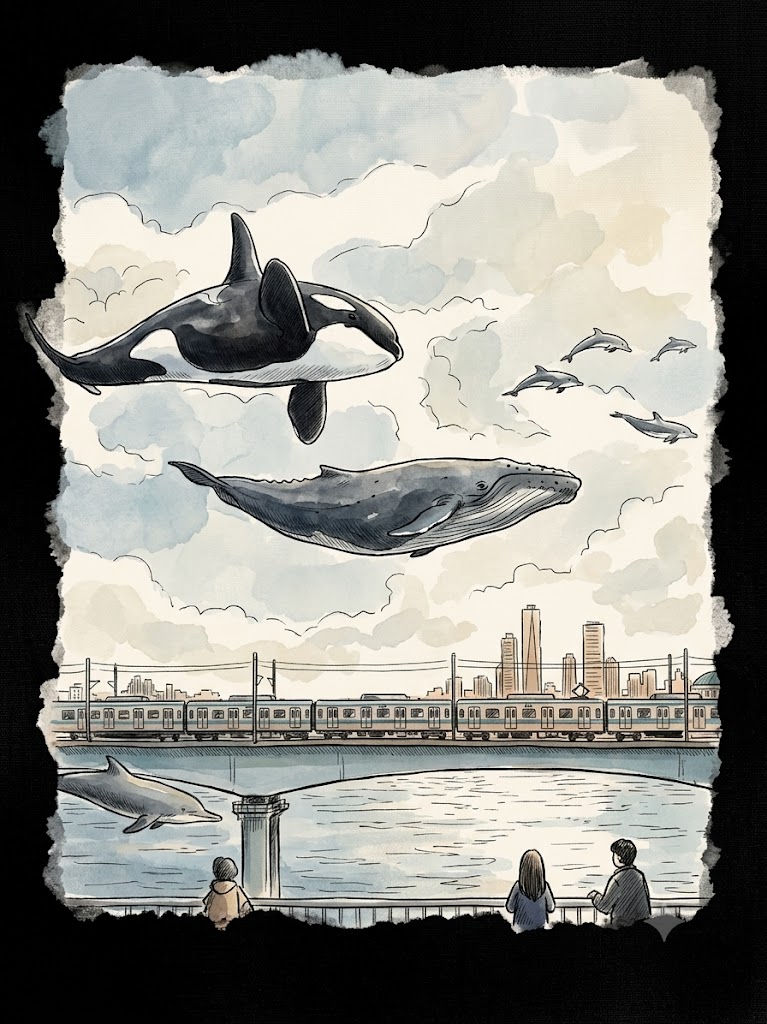 Same trick, every time: when the answer arrives, so does the whale.
It’s also worth knowing that the show’s love of whales connects to a real, ongoing conversation in Korea. In episode 4, Young-woo mentions three real Indo-Pacific bottlenose dolphins by name — Sampal-i, Chunsam-i, and Boksun-i — all of whom were held in captivity for aquarium shows before being released back into the waters off Jeju. That same species’ silhouette is what appears on Kyungpyo Construction’s dolphin logo in the hackberry tree case. The show ties its whimsical whale motif to an actual animal-welfare debate happening in Korea right now, about captive marine mammals and aquarium shows.
Whether the whale device works for you personally is one of the more common critical splits with this show. For most viewers it’s the single image people remember years later. For a smaller group, it can tip toward twee. Both reactions are reasonable — it’s a big swing for a legal drama to take, and the show takes it in nearly every episode.
How the Season Actually Ends
The finale isn’t really about Tae Soo-mi and Young-woo’s relationship — that thread mostly resolved back in episode 8. Instead, it circles back to Soo-mi’s son, Choi Sang-hyun, who confesses to his mother that he was behind a major cyberattack on a company called Raon. Soo-mi begs him to keep it quiet; she’s on the verge of a confirmation hearing for Minister of Justice and can’t afford the scandal.
Young-woo ends up representing Raon in the underlying case, which puts her in an impossible spot once she learns the truth about who the hacker actually is. The resolution hinges on her convincing Soo-mi to let Sang-hyun testify honestly rather than disappear the problem — and the way she does it is one of the best scenes in the finale. She compares herself to a narwhal: rare, valuable, easy to misjudge. She asks Soo-mi to be the mother to Sang-hyun that she never got to be to her. Soo-mi lets her son testify. She also withdraws from the Minister of Justice nomination and apologizes publicly for her son’s actions.
Kwon Min-woo’s quiet change of heart happens in this same stretch of episodes. So does Young-woo’s decision to stay with boyfriend Lee Jun-ho rather than break things off out of self-doubt. The show closes with Young-woo getting a full-time contract at Hanbada and riding the subway home — the same shot, deliberately, as the whale that passed her window in episode 1.
Reactions to how quietly all of this wraps up were genuinely mixed, both inside Korea and internationally — some viewers and reviewers found the ending overly neat, especially how fast Min-woo’s arc resolves without much accountability. Others read the restraint as consistent with the show’s whole approach: prioritizing Young-woo’s actual comfort over dramatic spectacle, rather than manufacturing a bigger confrontation just because the finale called for one. Both reactions are reasonable responses to the same creative choice.
If you found Kwon Min-woo’s arc satisfying but incomplete, that same “no dramatic reckoning” instinct is worth comparing to how My Mister handles its own quietly unresolved relationships.
Editor’s Pick
A personal note from the Editor.
The umbrella. That’s the scene I go back to. Not the courtroom speech, not the reveal — the moment Young-woo notices a stranger’s umbrella logo in a crowd of people at a muddy site inspection, because her brain simply cannot let a detail like that pass unfiled. Everyone else in that scene is having a completely normal, miserable, rainy day. She’s the only one who catches the thread that ends up saving the case, and she catches it because of the exact trait that makes her daily life harder. The show rarely explains this kind of moment. It just shows you the cost and the gift arriving in the same package, and lets you sit with both.
Watch These Next
▶ Watch the Extraordinary Attorney Woo Whale Scenes Compilation on YouTube
▶ Watch the Extraordinary Attorney Woo Finale Ending Explained on YouTube
Rating
9.0 / 10
The hackberry tree case is the show’s best hour, and the Soo-mi reveal is the best-acted. Docked slightly for a finale that resolves the Min-woo arc a little faster than the build-up earned.
Meet the Director, Writer & Cast
Yoo In-shik — Director. Directing Korean television since the early 2000s, with credits including Giant, Vagabond, and all three seasons of Dr. Romantic before this show. He’s said the biggest challenge was tone — finding the line between humor and mockery. The whale motif wasn’t in the original script; he added it himself, specifically so it would be something only Young-woo and the audience could see.
Moon Ji-won — Writer. Created Woo Young-woo after writing Innocent Witness, a courtroom drama about an autistic teenage witness that won the Grand Prize at the 2016 Lotte Scenario Contest. At the press conference, she described “strange” (이상한) as unusual, unfamiliar people who sometimes make others uneasy but also push the world forward.
Park Eun-bin — Woo Young-woo. Won the Television Grand Prize at the 59th Baeksang Arts Awards for this role. She deliberately avoided watching footage of real autistic people or prior autistic characters on screen, calling it an ethical line she didn’t want to cross, and built Young-woo from the script and clinical diagnostic criteria instead.
Kang Tae-oh — Lee Jun-ho. Young-woo’s steady, patient boyfriend and Hanbada colleague; this role significantly widened his audience across Southeast Asia.
Kang Ki-young — Jung Myung-seok. Young-woo’s gruff, big-hearted mentor, nicknamed her “sub-dad” by fans. The role turned him into a lead actor, headlining JTBC’s Queen of Divorce in 2024 after fifteen years of supporting work.
Jin Kyung — Tae Soo-mi. Plays Young-woo’s biological mother with real range — ambitious and cold in the courtroom, quietly devastated the moment her daughter’s identity becomes real to her.
Supporting Cast
A few more familiar faces from Hanbada and beyond, with official social links where we could independently confirm them (a couple of these names are common enough in Korea that search engines will surface the wrong person’s account, so where we couldn’t confirm one, we’ve said so instead of guessing):
- Ha Yoon-kyung as Choi Soo-yeon — @hayoonkie
- Joo Jong-hyuk as Kwon Min-woo — @joojong_
- Joo Hyun-young as Dong Geu-ra-mi — @2ruka__
- Jeon Bae-soo as Woo Gwang-ho — @baesooaa
- Baek Ji-won as Han Seon-young — not confirmed; see the agency’s official channels
Coming Up in This Series
Catch up:
- Part 1 — Spoiler-Free Intro: → Read Part 1
More K-Drama on K-Unpacked:
Korean culture, unpacked.