Editor's Masterpiece Walk — My Mister (나의 아저씨): More Beautiful Because It Is Not Love
My Mister is not a love story. It is about two broken people who simply see each other. That is why it stays with you so long after it ends.
⚠️ This post contains full spoilers for My Mister (Season 1).
👉 Related posts:
This is one of my personal Top 3 K-Dramas of all time.
This is not a review. It is the kind of thing you hold for a long time before you can put it into words.
Why Does a Dark Show Feel This Warm?
My Mister is not a bright drama.
The tone is heavy from the start. The main characters are both broken in their own ways. The company is corrupt. The neighborhood is worn down. The people are tired.
It is completely normal to wonder, around episode one: “Is this too sad for me?”
But something strange happens. The more you watch, the warmer you feel inside.
That is the paradox — and it is exactly what this drama is.
Sadness and warmth mixed together. Finding a person inside the dark. My Mister delivers that feeling very quietly, very precisely, across all 16 episodes.
The Two People
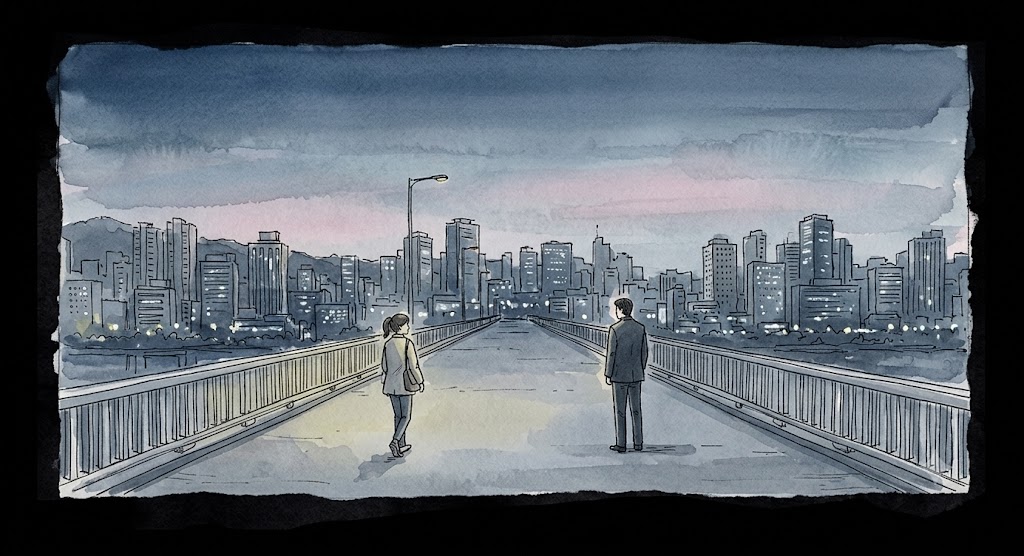
 Two people living in the same world, but in completely different places
Park Dong-hun (Lee Sun-kyun) is stuck in the middle of his life. Mid-40s. He is honest and hardworking — but he has learned that the world does not really reward those things. His wife is having an affair. His company is full of politics. His brothers need him. He carries everything quietly. And he does not know if he is okay.
Lee Ji-an (IU) is a closed person. Poverty, violence, her grandmother’s debt. From very early in life, all the world gave her was pain. So she hits first. She is cold first. She is mean first. Strike before you get struck — that is what she learned to do to stay alive.
These two people end up at the same company.
At first, they are enemies. Ji-an tries to trap Dong-hun in a scheme. Dong-hun does not know her situation. It looks like nothing will happen between them.
But Dong-hun sees Ji-an. He sees what is behind the cold, mean behavior. Ji-an has never been seen that way before — not once, in her entire life.
What the Drama Hides
The Wiretap — The Most Illegal Way to Make the Purest Connection
Ji-an taps Dong-hun’s phone. At first, she just wants to use him.
But then she hears his life.
Drinks with his brothers. A phone call to his mother. The quiet words he says to himself when things are hard.
The wiretap is illegal. The drama knows that. But what the drama uses it to say is something different.
The most real person is the one who speaks the same way when no one is watching.
Ji-an does not come to trust Dong-hun because of his face. She trusts him because of the words he says when he thinks he is alone. Those words were always the same. In front of people, or behind closed doors — the same.
Ji-an had never met anyone like that before.
The Bar — A Place Where Broken People Gather
Dong-hun goes to the same small neighborhood bar every night with his brothers. At first it just looks like background.
Look closer.
Everyone in that bar has failed at something. The oldest brother lost his business. The youngest brother Ki-hoon once screened a short film at Cannes at age 20 — and has been trying to make his feature debut for the twenty years since. And Dong-hun — whose wife is cheating on him. By the world’s standards, they are all losers.
But every single night, they sit in the same seats and drink the same beer. They know about each other’s failures. And they stay anyway.
That is what My Mister means by community. Not a group of people who are doing well. A group of people who are each a little broken — and still show up for each other.
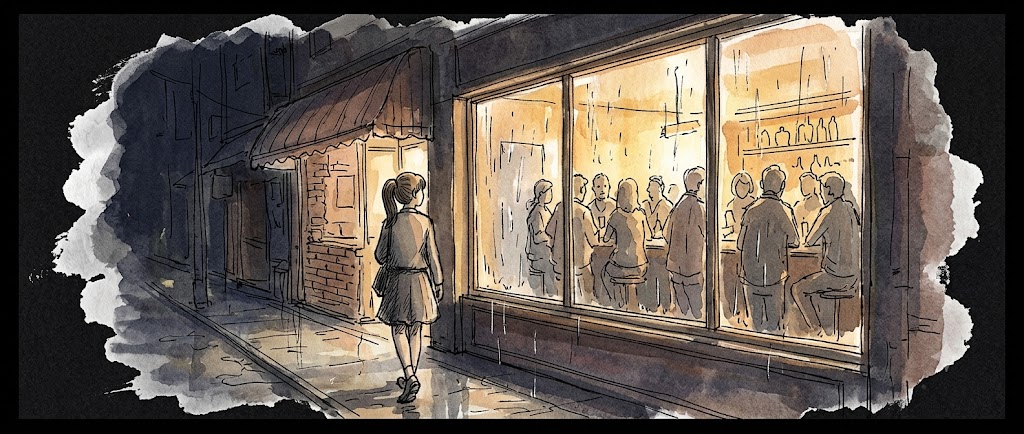
Ji-an never goes inside that bar. But one night, she stands outside and looks at the light through the window.
That one moment tells you everything she wants in life.
Ji-an’s Walk
Ji-an always walks fast. Head down. Like she is trying to take up as little space as possible.
Then, late in the drama, her walk changes.
It slows down. A little. Her head comes up. A little. There is no dialogue. No explanation from the narrator. Nothing but that small change in how she moves.
My Mister is a drama that talks through symbols and images — not words. This is how most of them work. It shows you. It does not tell you.
The Best Scenes
“Because I’m happy. That someone like that is beside me too.”
Ji-an visits her grandmother in a nursing home.
Her grandmother asks — in sign language — what kind of person Dong-hun is.
Ji-an begins to answer in sign language. Then she stops. Her eyes fill with tears.
Her grandmother asks: “What’s wrong?”
Ji-an answers:
“I’m just happy. That I have someone like that beside me too… I’m just happy.”
This line hits so hard for a reason that is not simple.
For Ji-an, this is not a confession of love. It is shock. The fact that someone like Dong-hun exists in her life — that was never something she thought was possible. Not once.
People cry at this scene not because it is sad. They cry because that joy came so late.
Sang-hoon’s Flowers
Ji-an’s grandmother dies.
There are no flowers at the funeral. Ji-an has no one.
Dong-hun’s older brother, Sang-hoon, takes all the money he had been secretly saving — and orders flower wreaths from his neighborhood friends’ shops. A towel store. A fish store. Small, ordinary stores. He puts their names on the wreaths and fills the room.
This is Sang-hoon. Not the main character. Not someone with a direct connection to Ji-an.
This scene is where My Mister finally says what it has been trying to say all along.
What one person can do for another does not have to be great. A wreath with the name of a fish store on it — in that moment, it becomes one of the most beautiful things in the world.
The Last Scene — “I’ll Buy You Dinner, Mister.”
Years have passed.
It is spring. Sunlight fills a small city café. Dong-hun and Ji-an run into each other — by chance, the way people do when life has simply moved on.
Ji-an looks different. Her face is brighter. Her clothes are lighter. She is laughing with colleagues her own age across the room. The person standing in front of Dong-hun is not the Ji-an who used to walk fast with her head down, trying to take up as little space as possible.
Dong-hun’s face does something it rarely did in this drama. It softens. He smiles — genuinely, warmly — like someone seeing proof that a hard thing worked out.
They talk easily. Work. Nothing heavy. Then her colleagues call her name from across the café.
She shakes his hand. She smiles.
And then she says — in the most ordinary Korean way:
“I’ll buy you dinner sometime, mister. I want to treat you to something good. I’ll call you!”
She turns and walks away.
Dong-hun watches her go. The expression on his face is not the face of someone who lost something. It is the quiet, proud smile of a real adult who watched something small and broken grow into something whole.
The background music comes in softly: “Close your eyes — and you can see yourself. Not tired. Just resting for a moment.”
Then, in voiceover — just between the two of them, heard only in the heart:
Dong-hun: “Ji-an. Have you arrived at peace?”
Ji-an: “Yes… yes.”
The long story ends there. Two people. One quiet question. One quiet answer.
Why This Ending Is Perfect — And What Foreign Viewers Almost Certainly Missed
The reversed sentence.
Ji-an’s last line — “I’ll buy you dinner” — sounds completely ordinary. In Korea, it is one of the most common things a person says when saying goodbye. Everyone says it. Half the time, nobody calls.
But this drama made us earn that ordinariness.
The very first real moment between Dong-hun and Ji-an was a cold, dark winter night. Ji-an said: “Buy me dinner.” It was not an invitation. It was a demand. The words of someone who expected to be refused. A test to see if this person was like all the others.
The same idea returns at the very end. But everything about it has flipped.
| First Meeting | Final Scene | |
|---|---|---|
| Season | Dark winter | Warm spring |
| Direction | Ji-an asks Dong-hun | Ji-an offers Dong-hun |
| Tone | Demand, cold | Gift, warm |
| Words | “Buy me dinner.” | “I’ll buy you dinner.” |
| Feeling | Anxiety | Peace |
The relationship that began in anxiety ends in peace. That single reversal holds the entire arc of the drama — without a single word of explanation.
The Hidden Meaning in Ji-an’s Name
This is something most international viewers miss completely. And it is the last quiet gift the drama hides.
Korean names are almost always written in Chinese characters — hanja (한자) — and each character carries a meaning. The show never explains Ji-an’s name. It does not need to.
지안 (至安)
| Character | Sound | Meaning |
|---|---|---|
| 至 | 지 (ji) | To arrive · To reach |
| 安 | 안 (an) | Peace · Comfort · Rest |
Ji-an: The one who arrives at peace.
Dong-hun’s very last line is: “Ji-an — have you arrived at peace?”
In Korean, he is literally asking: have you become your own name?
The moment this lands, the whole drama rearranges itself in your mind.
This was not simply a story about a man helping a troubled young woman. This was the story of a child named Peace — who spent her entire life not knowing what her own name meant — finally, slowly, living it.
The answer was written into her name before the first frame rolled.
The drama was called that all along.
About IU
IU is a singer. One of the most famous in Korea. Before people watched this drama, many of them wondered: “Can she actually act?”
That question disappears around episode two.
Ji-an does not speak much. She does not show expressions. She is a character who communicates with her eyes. IU did that. Not cute. Not pretty. Just Ji-an.
In one scene — Ji-an eating alone at a convenience store — you can feel her entire life history. Without a single word.
That is not good acting. That is becoming the person.
What This Drama Left Behind
My Mister is not a love story.
There is no romance between the two main characters. That decision is what makes this drama extraordinary.
Instead, this drama asks you a question.
Is there someone beside you who simply sees you? Without judging. Without expecting. Just knowing that you are there.
Dong-hun was that for Ji-an. Ji-an was that for Dong-hun. They did not save each other. They just made sure the other one did not disappear.
That was enough.
And that is why we cannot forget this drama.
📋 Quick Facts
| Title | 나의 아저씨 — My Mister |
| Aired | March 21 – May 17, 2018 |
| Channel | tvN |
| Episodes | 16 |
| Director | Kim Won-seok |
| Writer | Park Hae-young |
| Stars | Lee Sun-kyun · Lee Ji-eun (IU) |
| Awards | 55th Baeksang Arts Award — Best TV Drama · 31st Korean Broadcasting Writers Award |
🌍 The World Noticed
Japanese composer and pianist Ryuichi Sakamoto praised My Mister on his radio program Radio Sakamoto in January 2021 — introducing the OST track Grown-up by Sondia and saying he had watched the drama twice all the way through. Brazilian author Paulo Coelho called it “a work that perfectly depicts human psychology” and praised the script, direction, and cast. French actor Sébastien Roche wrote on Twitter that it was “an astonishingly complex story with unforgettable characters.” LE SSERAFIM’s Miyawaki Sakura said on her radio program that it was her favorite drama and that it made her rethink her view of life.
All of them watched it in subtitles. In a language they do not speak.
And all of them said the same thing: they could not forget it.
🔗 Read More
- Most Watched K-Dramas of All Time — Top 10 →
- Queen of Tears — The Show That Made the World Cry →
- Squid Game Season 1 — The Show That Stopped the World →
- Parasite — The Film That Changed Oscar History →
- See all K-Drama posts →
Aired: 2018, tvN · Director: Kim Won-seok · Writer: Park Hae-young