Parasite: Ending Explained & Every Hidden Symbol ⚠️ Full Spoilers
Full spoiler breakdown of Parasite — the garden party explosion, the rock, the smell, the stairs, the ending, and why Korean and global audiences reacted so differently.
⚠️ FULL SPOILERS AHEAD. Watch the movie first. Haven’t seen it yet? → Part 1: Spoiler-Free Introduction →
👉 This is Part 2 of a 2-part series — the ending, full symbolism breakdown, and the director & cast profiles below.
💥 The Scene — The Garden Party Explosion
Everything falls apart at Da-song’s birthday party — but the chaos that leads there actually begins the night before.
While the Parks are away on a canceled camping trip, the Kim family is discovered by Moon-gwang, the former housekeeper, who reveals that her husband Geun-se (Park Myung-hoon) has been hiding in a secret bunker beneath the house for years — surviving there after his bubble tea business failed and he went into debt to loan sharks. A struggle breaks out between the two families. Then the Parks call, saying they’re coming home early because of a sudden storm.
The Kims subdue Moon-gwang and Geun-se, tie them up in the bunker, and scramble to erase every trace of themselves before the Parks arrive. Hiding under a coffee table, Ki-taek, Ki-woo, and Ki-jung overhear Mr. Park making a dismissive comment about Ki-taek’s smell. Once the Parks are asleep, the three Kims sneak out into the storm and make their way home — only to find their own semi-basement already flooded with sewage water. They spend the night in a school gymnasium with other displaced families.
The next morning, under a clear sky after the storm, Mrs. Park impromptu-organizes a garden party to make up for the ruined camping trip — and calls the Kims in to help. With nowhere else to go and no time to process the previous night, the family puts their uniforms back on and returns to work.
During the party, Ki-woo goes down to the bunker carrying the scholar’s rock — his reasons for bringing it are left ambiguous, though it’s implied he may be trying to resolve things with Geun-se rather than simply attack him. He finds that Moon-gwang has died from injuries sustained in the fight the night before. Geun-se, now unraveling with grief and rage, ambushes Ki-woo and beats him with the same rock, leaving him badly injured. Geun-se then climbs the stairs, walks out into the party, and stabs Ki-jung with a kitchen knife in front of the horrified guests.
Why This Scene Shocked the Whole World
Reason 1: The genre switch. Audiences thought they were watching a dark comedy. Then real violence starts — suddenly, without warning. Many viewers were not ready.
Reason 2: Ki-taek’s knife. As chaos erupts, Mr. Park recoils from Geun-se’s smell while scrambling for his car keys to get his son to the hospital — the same “poor person’s smell” comment Ki-taek had overheard the night before, now aimed at someone else but landing just as hard. Ki-taek, already reeling from his daughter’s stabbing and the accumulated weight of the Parks’ casual contempt, stabs Mr. Park and flees.
Reason 3: The rock. Ki-woo is struck with the very scholar’s rock his friend gave him as a symbol of coming fortune. The object meant to represent his family’s rise becomes the object that nearly kills him.
🪢 Symbol 1 — The Line (선)
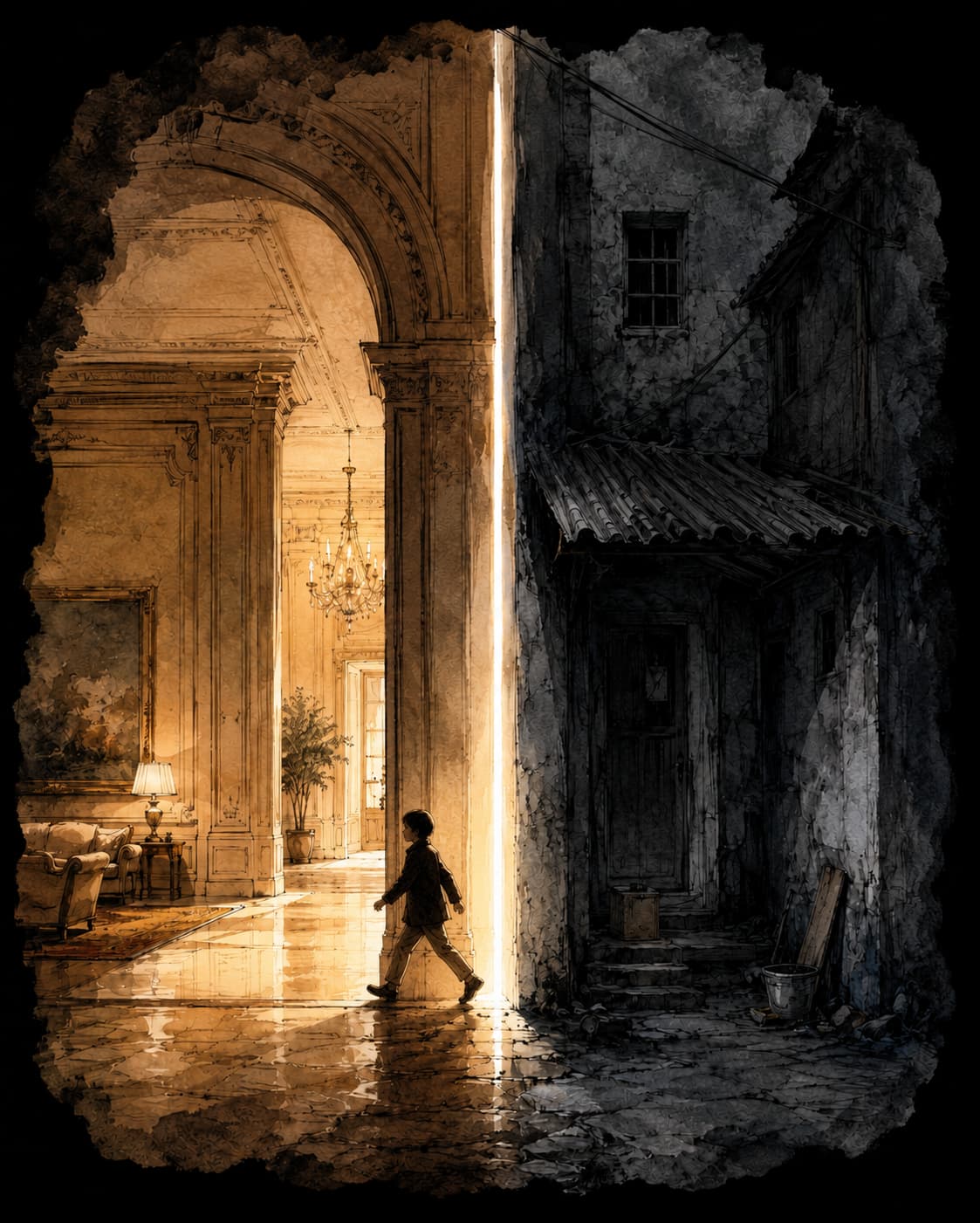 Two worlds. One line. The boundary that cannot be crossed.
💡 About Bong Joon-ho’s nickname: Bong Joon-ho is widely known in the film industry and among audiences as “Bong-tail” (봉테일 — Bong + Detail), a nickname reflecting his famously meticulous, detail-obsessed directing style.
The editor’s view: the true center of Parasite is not class. It is the line between classes — and who is allowed to cross it.
Bong Joon-ho draws this line literally. Throughout the film, frames are constructed around a single visible boundary: a window frame, a glass partition, a doorway threshold, a staircase edge. And every character’s relationship to that line tells you exactly where they stand.
🎬 ▶ Search for ‘Parasite mise-en-scène line analysis’ on YouTube (Several Korean-language video essays cover this in depth — English summary below)
Part 1 — Those Who Guard the Line vs. Those Who Enforce It
Moon-gwang at the window. Early in the film, housekeeper Moon-gwang needs to wake Mrs. Park, who is sleeping in the garden. The camera frames a clear line — the window ledge. Moon-gwang reaches her arm across it. But her body stays firmly on the outside. She extends only as far as she must, then pulls back. She knows exactly where she is allowed to be.
Ki-taek’s first meeting with Mr. Park. A glass partition separates them. Mr. Park barely registers Ki-taek’s presence. Ki-taek stands still on his side of the glass, hands clasped together, not moving forward. The line between employer and employee is made literal. No dialogue needed.
Mr. Park’s philosophy. At one point, Mr. Park explicitly says: “I hate people who cross the line.” He isn’t speaking metaphorically in that moment — but the idea of “the line” recurs throughout the film in other forms: a former driver accused of overstepping, Moon-gwang described as someone who never crossed it, Ki-taek reassured that he stays near the line but doesn’t cross it, and — later — Ki-taek’s smell described as something that does cross it.
Part 2 — The Line Begins to Break
Da-hye descending the stairs. When Mr. Park’s daughter becomes interested in Ki-woo, the camera shows her walking down the staircase — physically crossing into a lower level — to spy on him. The line bends before it breaks. Their eventual kiss completes the crossing.
The day the Parks go camping. Ki-taek’s wife Chung-sook steps deliberately through the parking garage door — past a threshold she would never have crossed before. Then, inside the empty mansion, one by one:
- Ki-woo’s body sprawls across a garden lounger, crossing the property line entirely
- Ki-woo opens the refrigerator — a boundary that was never his to open
- In Ki-jung’s bathroom scene, a rolling water bottle drifts past the tile line on the floor
- Ki-taek and Chung-sook fall asleep on the sofa, bodies crossing every spatial boundary the house had maintained
Each crossing is small. Together they build into something the film has been quietly preparing: the moment when the Ki-taek family fully inhabits a world that was never meant to include them.
Part 3 — The Crossing That Cannot Be Real
In the film’s ending, Ki-woo imagines saving enough money to buy the Park mansion. He pictures his father emerging from underground. He pictures the family together, in that house, in the light.
In this fantasy — and only in this fantasy — everyone crosses the line completely.
The camera shows it happening. And the camera shows us we are watching a dream. Ki-woo is still in the semi-basement, looking up. The line is still there. The crossing is still impossible.
One way to read this sequence: it’s a plan to cross a line that, within the film’s world, may never actually be crossable.
The Detail That Will Haunt You
A Korean film analysis channel (기생충 미장센 완벽 해부) made an observation while going through the film frame by frame: with the notable exception of Ki-jung’s bathroom scene, many of the film’s visible structural lines — window frames, glass partitions, doorways, staircase edges — appear rigidly vertical or horizontal, rarely tilting even during camera movement.
This is one video essayist’s close-reading observation, not a production rule Bong Joon-ho has confirmed in interviews. But it fits the film’s broader visual language: Bong has spoken about using boundaries, thresholds, and framing to draw a literal line between the Park family’s world and everyone outside it.
This is part of what “Bong-tail” means — a director whose films reward this kind of frame-by-frame scrutiny.
👃 Symbol 2 — The Smell
Mr. Park tells his wife that Ki-taek has a smell. “The smell you get on the subway.” He says the same thing about other working-class people around him.
The smell is class made visible. You cannot see it. But wealthy people use it to identify poor people. And that identification is dehumanization.
Ki-taek knows this. He endures it. But at the garden party, when Mr. Park reflexively recoils from Geun-se’s smell — the same “poor person’s smell” comment aimed at him the night before — something in Ki-taek breaks. Years of accumulated humiliation, on top of watching his daughter bleeding out and Mr. Park’s total indifference to it, converge in that instant.
Bong Joon-ho has explained that smell works as an especially effective class marker in the film because domestic work — tutoring, driving, housekeeping — puts rich and poor people into physically intimate spaces where they can, quite literally, smell one another. It’s one of the few class signals that can’t be disguised with new clothes or polished speech.
🪜 Symbol 3 — The Stairs
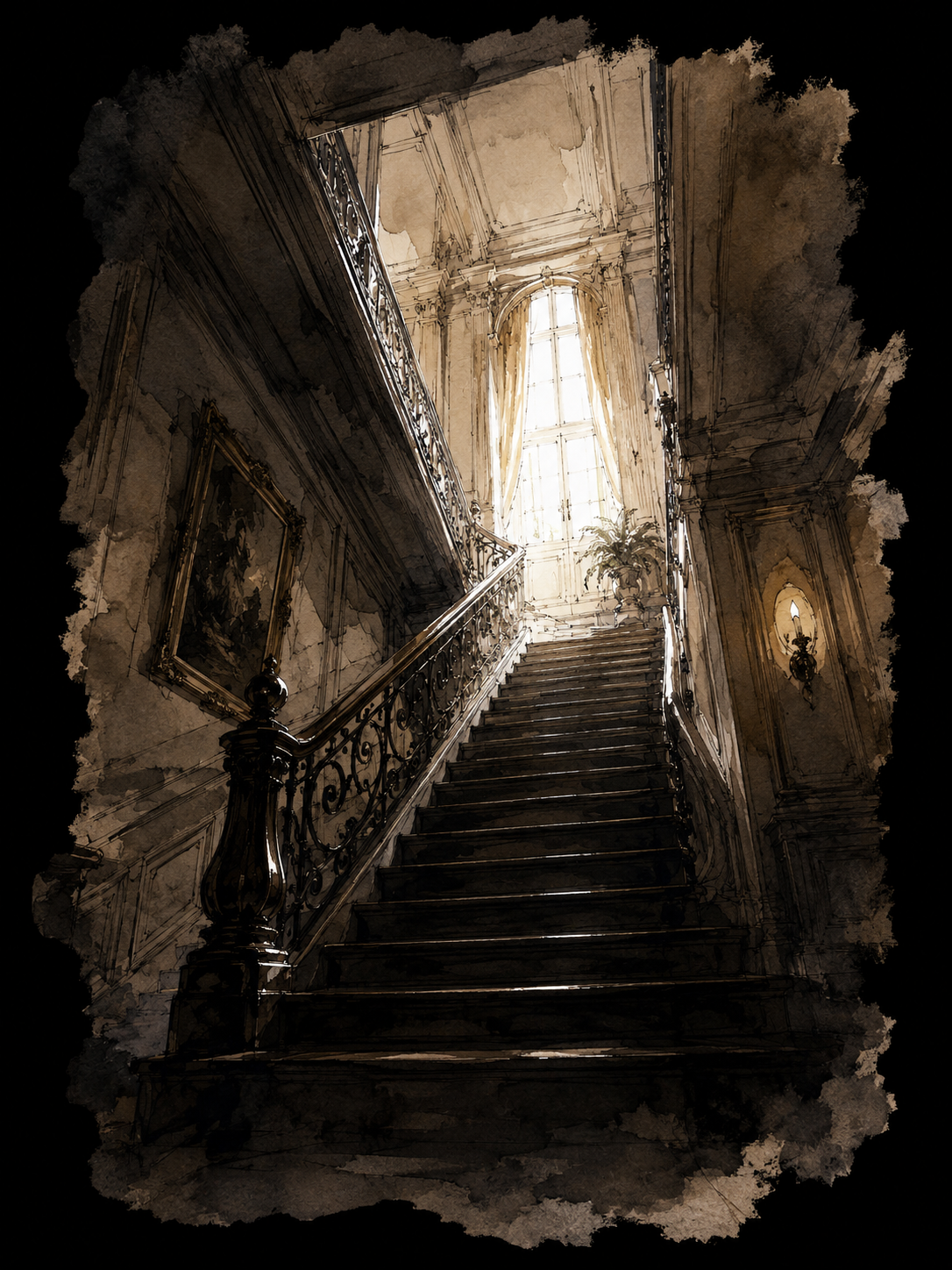 The staircase — Parasite’s central visual metaphor
Bong Joon-ho called this film “a staircase movie.”
| Space | Class Level |
|---|---|
| Park mansion (on the hill) | The top |
| Street level (the city) | The middle |
| Ki-taek’s semi-basement | Below ground |
| Underground bunker (Geun-se) | Erased from existence |
Many of the film’s most important transitions are staged on or around stairs — going up looks like hope, going down is the return to reality.
The night of the rainstorm — the Ki-taek family running from the mansion back to the semi-basement — is an endless descent. From the beautiful house to a home filling with water. That one scene compresses the physical reality of class into a single image.
🌧️ Iconic Scene: The Night of the Flood
The most-discussed scene in the film. As the Kims escape the Park mansion through the storm and make their way home, rain is already flooding their neighborhood. By the time they arrive, their semi-basement is already submerged in sewage water.
Why global audiences were shocked: The same storm that merely delays the Parks’ camping trip — cleared away by the next morning into a “blessing in disguise,” as Mrs. Park puts it — destroys everything the Kim family owns. Even nature treats people differently depending on their class. This felt too direct and too true.
Why Korean audiences felt it differently: In 2022, a family drowned in a flooded semi-basement during heavy rain in Seoul. Following that tragedy, many journalists and viewers revisited the film’s flood sequence as an uncomfortably accurate reflection of real housing vulnerability in the city.
🏁 The Ending — Explained
Ki-taek stabs Mr. Park and disappears into the underground bunker. Ki-woo survives, badly hurt. Ki-jung is dead. Chung-sook is injured.
Ki-woo looks at the Park house from a distance and writes a letter in his mind. Someday, he will earn enough money to buy that house. Then his father can come out.
But here is what the camera shows: Ki-woo is standing in the semi-basement, below street level. Looking up. It is a fantasy. Bong Joon-ho and actor Choi Woo-shik have noted that, doing the math on an average income, it would take Ki-woo several hundred years to actually save enough to buy that house — a calculation meant to underline just how impossible his dream really is.
Bong presents Ki-woo’s dream and its impossibility at the same time.
The film’s final question: Within the economic reality the film presents, is Ki-woo’s plan to change his family’s fate ever actually achievable — or is class, like a smell, something that clings no matter how hard you try to wash it off?
🌍 Possible Cultural Readings — Not Universal Audience Reactions
(These are interpretive possibilities, not the results of any survey — individual reactions to the film vary widely regardless of nationality.)
| Scene | A Reading Some International Viewers Might Have | A Reading Some Korean Viewers Might Have |
|---|---|---|
| Ram-don (Chapaguri) | An unfamiliar, curious food combination | Instant recognition of the dish and its “cheap noodles + expensive beef” class contrast |
| Mr. Park’s smell comment | A clearly unpleasant, classist remark | Something that may echo real workplace or service-industry experiences |
| The flooding semi-basement | A shocking, dramatic disaster sequence | For some, especially since 2022, a scene that resonates with real housing vulnerability |
| Ki-taek’s stabbing | A sudden, jarring burst of violence | Some viewers describe the buildup as feeling emotionally inevitable in hindsight |
| The ending | Frequently described as “open-ended” | Some viewers read Ki-woo’s plan as clearly, tragically impossible from the start |
Bong Joon-ho himself has said the class dynamics in the film aren’t unique to Korea — he’s described capitalism’s pressures as something audiences everywhere recognize, which is part of why the film traveled so widely.
💡 What the Film Seems to Be Saying
A central motif running through Parasite is the repeated making and collapse of plans. Early in the film, Ki-taek tells his son that the safest plan is no plan at all — because a plan that fails is worse than having none. That idea returns again and again, ending with Ki-woo’s own impossible plan to buy the house.
Bong Joon-ho has described the film as a kind of tragedy without a clear villain — in the official Cannes press materials, he called it “a comedy without clowns, a tragedy without villains.” Neither the Kim family nor the Park family is evil in any simple sense; it’s the imbalance between them, and the pressure to survive, that pushes everyone toward violence.
🎬 Meet the Director & Cast
Bong Joon-ho (봉준호) — Director
Bong Joon-ho is the most singular director in Korean cinema. He does not belong to one genre — a monster movie is actually about family, a murder mystery is really about Korean modern history, a black comedy becomes a war between the classes. He studied sociology at Yonsei University, and that background shows up in every film: there’s always a hidden question underneath about why society works the way it does.
At the Oscars, accepting Best Director, he paraphrased a line he says he carved into his heart as a young film student: “The most personal is the most creative,” crediting the idea to Martin Scorsese, who was seated in the audience.
| Full Name | 봉준호 (Bong Joon-ho) |
| Born | September 14, 1969 |
| Education | Yonsei University — Sociology |
| Key films | Memories of Murder (2003) · The Host (2006) · Snowpiercer (2013) · Okja (2017) · Parasite (2019) · Mickey 17 (2025) |
💡 Fun fact: In his early twenties, Bong Joon-ho worked as a private tutor for a wealthy family’s child — the seed that grew into Parasite, where Ki-woo also enters the Park household as a tutor.
A director who films class vertically. Bong Joon-ho did not invent the “class” theme, but he found a visual language for it that nobody else uses quite the same way. Watch any Bong Joon-ho film closely and stairs, floors, and levels show up again and again. In Snowpiercer, an entire movie takes place inside a single train, and the whole plot is about pushing forward from the poor cars in the back to the rich cars at the front. Parasite folds that same idea into one house instead of one train — the Kim family low in their semi-basement, the Park family high on a hill with a long staircase leading up to their door. It is part of why critics call his films “vertical”: the story moves up and down almost as much as it moves forward.
The Cast
Song Kang-ho (송강호) — Ki-taek. The living legend of Korean cinema, and Bong’s most frequent collaborator across four features. Ki-taek is not a simple villain — he’s a human being audiences understand, which is exactly what makes the ending hit so hard. Song won Best Actor at Cannes in 2022 for Broker.
Choi Woo-shik (최우식) — Ki-woo. Everything in the story flows from Ki-woo’s first decision, so his performance sets the tone for the whole film. Raised partly in Vancouver and fluent in English, which adds credibility to his role as an English tutor.
Park So-dam (박소담) — Ki-jung. Smart, bold, and dangerous. In 2021 she was diagnosed with papillary thyroid cancer and stepped back from public activities during recovery, returning to public appearances in late 2022 and making a more visible return to acting with Phantom (2023).
Lee Sun-kyun (이선균) — Mr. Park. Not written as a villain, just a wealthy man who has always lived inside the walls of his class — that ordinariness is what makes him frightening. He died in December 2023 during a highly publicized police investigation; Parasite remains his most internationally recognized performance.
Jo Yeo-jeong (조여정) — Yeon-kyo. Kind, or performing kindness, or genuinely naive — the ambiguity is the point. Her kindness becomes a tool of the class system without her ever meaning it to. She won the Blue Dragon Film Award for Best Actress for this role.
💡 Why the ensemble worked: No single actor dominates. Song Kang-ho holds the center, Choi Woo-shik drives the story forward, Park So-dam adds danger, and Lee Sun-kyun and Jo Yeo-jeong create the contrast that makes the class divide visible on screen.
👉 Continue Reading
Analysis based on director interviews, critical reception, and cultural context.