SEVENTEEN Part 2 — The Self-Made Machine: How Thirteen Members Built Their Own Sound
How SEVENTEEN turned a crowded 13-member lineup into a creative system — writing songs, building choreography, winning their first music show trophy, and growing into one of K-pop's most reliable performance groups.
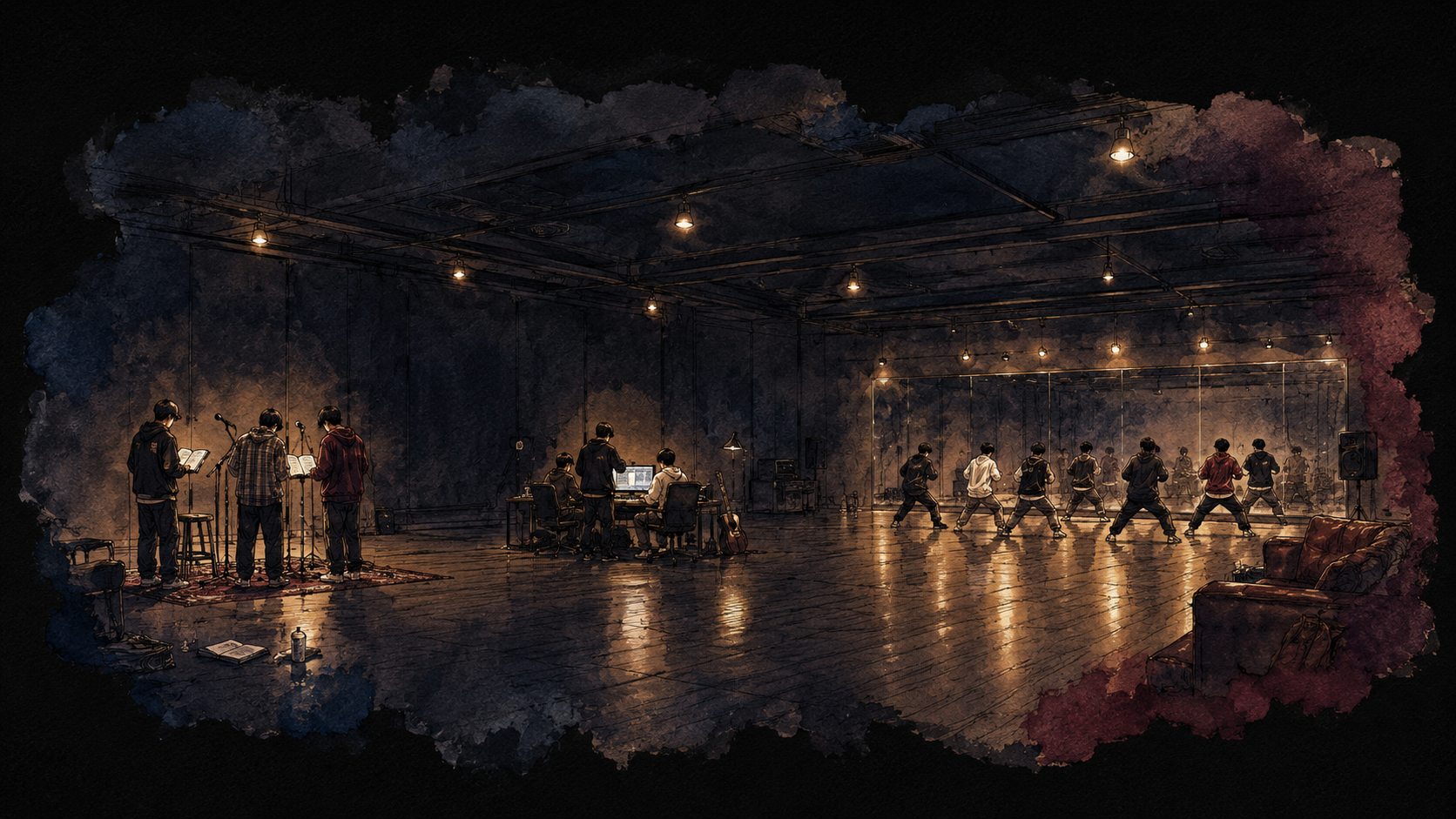
In Part 1, the Editor told the story of Ana — the Indonesian teenager who taught herself Korean because she wanted to understand SEVENTEEN.
But Ana did not fall in love with SEVENTEEN only because there were thirteen members. She stayed because the group felt different.
Their songs carried the members’ own names in the credits. Their choreography seemed designed around thirteen individual bodies rather than copied onto thirteen identical performers. Their variety content felt less like a company advertisement and more like a group of longtime friends trying to make each other laugh.
SEVENTEEN did not simply perform a finished product. They helped build it.
That idea became the center of their identity: the self-producing idol group.
It sounds simple today. Many K-pop artists now participate in songwriting, choreography, or production. In 2015, however, it was still a risky way to introduce a rookie group from a relatively small company. Pledis Entertainment was asking the public to trust thirteen unfamiliar young men — and asking those young men to help create the very music that would decide whether they survived.
This is how the machine began to work.
K-Unpacked’s take: It’s worth being precise about why “self-producing” was a genuine gamble in 2015 rather than just an appealing marketing line. A company the size of Pledis could not fall back on a Big Three label’s insulation if the bet failed — no deep bench of proven producers to quietly fix a weak song, no guaranteed broadcast slots to cushion a cold reception. Handing thirteen unproven trainees real creative authority meant that if the music was mediocre, there was no one else to blame and no safety net underneath it. The fact that it worked is part of why “self-producing idol” later became a status marker other groups actively adopted (Stray Kids’ 3RACHA is the clearest parallel on this site) rather than staying a one-off experiment — SEVENTEEN essentially proved the model was viable for a mid-sized company, not just a fluke of thirteen unusually talented individuals.
📌 This is Part 2 of a 4-part SEVENTEEN series.
- Part 1 — Thirteen Strangers, One Vision
- Part 2 — The Self-Made Machine ← you are here
- Part 3 — Going Global
- Part 4 — The Empire of Seventeen
⚙️ Thirteen Members, Three Creative Engines
A thirteen-member group can easily become confusing. Too many faces. Too many voices. Too little time for each member to stand out.
SEVENTEEN solved that problem by building the group around three specialized units.
| Unit | Leader | Members | Main Role |
|---|---|---|---|
| Hip-Hop Team | S.Coups | S.Coups, Wonwoo, Mingyu, Vernon | Rap, lyrics, musical identity |
| Vocal Team | Woozi | Jeonghan, Joshua, Woozi, DK, Seungkwan | Vocals, melody, emotional center |
| Performance Team | Hoshi | Jun, Hoshi, The8, Dino | Dance, formations, visual storytelling |
The structure is practical. Woozi could focus on the sound. Hoshi could focus on movement. S.Coups could guide the members as the overall leader while also leading the Hip-Hop Team.
But the units were never completely separate. Rappers contributed lyrics. Vocalists helped shape songs. Performance members participated in choreography and stage ideas. Unit tracks gave smaller groups of members more room to show their own colors.
Thirteen people did not have to fight for one small spotlight. They could build several spotlights — and then bring them together.
That is the real meaning behind the group’s famous equation: 13 members + 3 units + 1 team = SEVENTEEN.
🎼 Woozi: The Sound at the Center
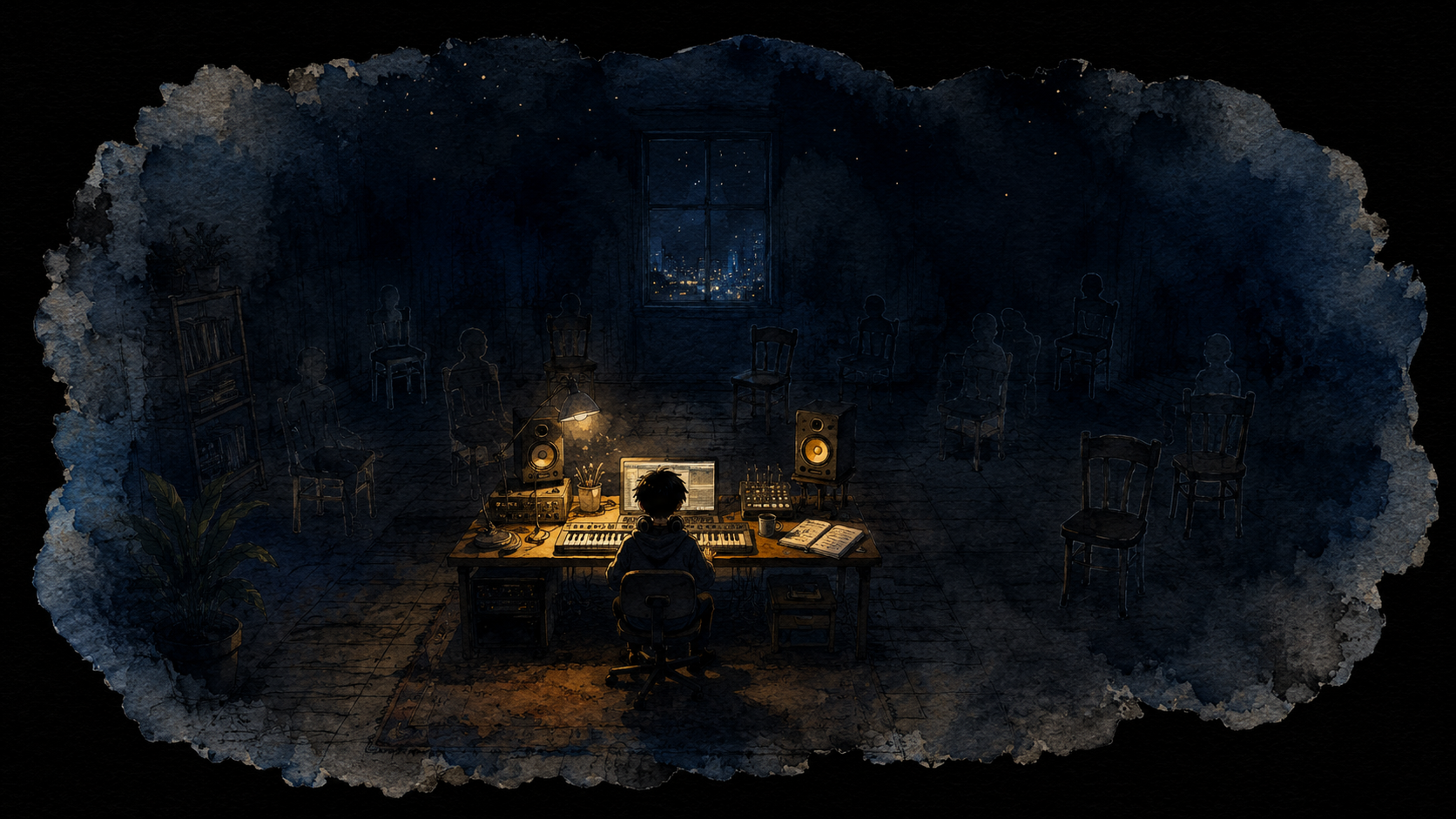 The chair CARATs know best — quiet, late, and never really alone.
The group’s sound was not delivered from somewhere outside. It was built from inside the team.
Woozi is often introduced as SEVENTEEN’s producer. That description is correct, but it can also be misleading. He did not work alone.
Longtime producer Bumzu and other professional songwriters, composers, arrangers, and choreographers have played major roles in SEVENTEEN’s music. The group’s work has always been collaborative. What makes Woozi important is that one of the group’s own members has remained near the center of that collaboration.
From the debut EP 17 Carat, Woozi participated in writing and composing all five tracks. Other members also contributed lyrics, while Hoshi helped create choreography for key early performances such as “Adore U” and “Shining Diamond.”
The songs were not created by thirteen teenagers working in complete isolation. But they were also not anonymous products handed to the members on the day of recording. The members had a voice in what SEVENTEEN would sound like.
That difference mattered. As the group grew older, the music could grow with them. Their early songs were bright and youthful. Later albums explored anxiety, ambition, exhaustion, friendship, and the fear of losing momentum. The style changed because the people making the music were changing too.
Woozi became the bridge between those changes. He understood the members’ voices because he had trained beside them. He knew which singer could carry a difficult emotional line. He knew when a rapper needed more space. He knew how a song would need to move once thirteen people stood onstage.
The production system was not separate from the group. The production system was the group.
💎 17 Carat: Small Album, Clear Identity
SEVENTEEN officially debuted through a showcase and broadcast event on May 26, 2015. Their debut EP, 17 Carat, followed at the end of that week.
The album was small. Five songs. A young group. Limited resources. But the identity was already visible.
“Adore U” did not try to make SEVENTEEN look dark, dangerous, or untouchable. It presented them as energetic young men trying to express a very simple feeling: liking someone so much that standing still becomes impossible.
The song was playful. The choreography was even more important.
Members moved in and out of formations. One person became the center, then disappeared. Small groups created mini-scenes while the rest of the team built the background. The stage was constantly changing, even when the camera stayed still.
This became a SEVENTEEN signature. Thirteen members were not treated as a problem to hide. They were used as a visual tool.
17 Carat later became the longest-charting K-pop album released in 2015 on Billboard’s World Albums chart. Billboard critics also included it in their list of the ten best K-pop albums of that year — the only rookie-group album on the list.
For a debut from a small company, that was an unusually strong start. But SEVENTEEN still needed a true breakthrough in Korea. That arrived one year later.
🛋️ “Pretty U”: The Stage That Changed Everything
“Pretty U” did not look like a standard K-pop performance. The members used a sofa as part of the choreography. They jumped over it, leaned against it, hid behind it, and turned it into a moving stage prop.
At times, the performance felt closer to musical theater than an idol dance routine. Each movement helped tell the song’s story: a nervous young man trying to confess his feelings but repeatedly losing his courage.
The choreography was detailed without feeling heavy. The members smiled, ran, fell, shouted, and moved as if thirteen friends had suddenly taken over a theater stage.
On May 4, 2016, “Pretty U” gave SEVENTEEN their first music-show win on MBC M’s Show Champion. The members cried. During the encore celebration, they attempted one of their chaotic group formations and collapsed into a laughing pile.
It was not a perfectly controlled victory scene. That made it feel more like SEVENTEEN.
☀️ “VERY NICE”: The Song That Refused to End
A few months later, SEVENTEEN released “VERY NICE.” The song did not win a music-show trophy during its original promotion period.
It did something more valuable. It refused to disappear.
“VERY NICE” became one of the group’s most recognizable songs and eventually one of the most famous concert endings in K-pop.
At a SEVENTEEN concert, the final chorus may play again. Then again. Then again.
The members leave the stage. The music returns. They run back out. Fans scream. The ending begins once more. The exact number of repeats changes from concert to concert. The joke is that “VERY NICE” never truly ends.
But the repeated encore is more than a joke. It captures the relationship SEVENTEEN built with CARATs. The group does not simply finish a performance and walk away. They stretch the last moment until everyone is exhausted, laughing, and fully involved.
A song released in 2016 became a ritual shared by audiences around the world. That is how a hit becomes part of a group’s culture.
🌧️ “Don’t Wanna Cry”: A More Serious SEVENTEEN
By 2017, SEVENTEEN’s stages had become larger, sharper, and more emotionally controlled. In 2017, SEVENTEEN changed direction with “Don’t Wanna Cry.”
The bright colors became softer. The smiles disappeared.
The choreography used long lines, mirrored movements, and waves of bodies moving across the stage. Instead of acting like excited teenagers, the members performed the emptiness left after a separation. The song showed that SEVENTEEN could be emotionally serious without losing the precision that defined them.
“Don’t Wanna Cry” won Best Dance Performance Male Group at the 2017 MAMA Awards. In 2018, SEVENTEEN won the same category again with “Oh My!”
The two songs were very different. One was restrained and sad. The other was warm and playful.
But both depended on the same strength: turning thirteen people into one moving picture.
Around this period, SEVENTEEN became widely recognized for large-scale formations and reliable live stages. Their performances were not impressive only because everyone moved at the same time. The real strength was design.
A member could cross the stage while twelve others opened a path. A small gesture at the back could become the center of the next formation. The choreography gave the viewer many things to watch without making the stage feel disorganized.
Thirteen members created complexity. Good choreography turned that complexity into clarity.
🧭 Why SEVENTEEN’s Choreography Feels Different
K-pop synchronization is often judged by one question: Are all the members moving in exactly the same way?
SEVENTEEN’s best performances ask a different question: Can thirteen different bodies create one story?
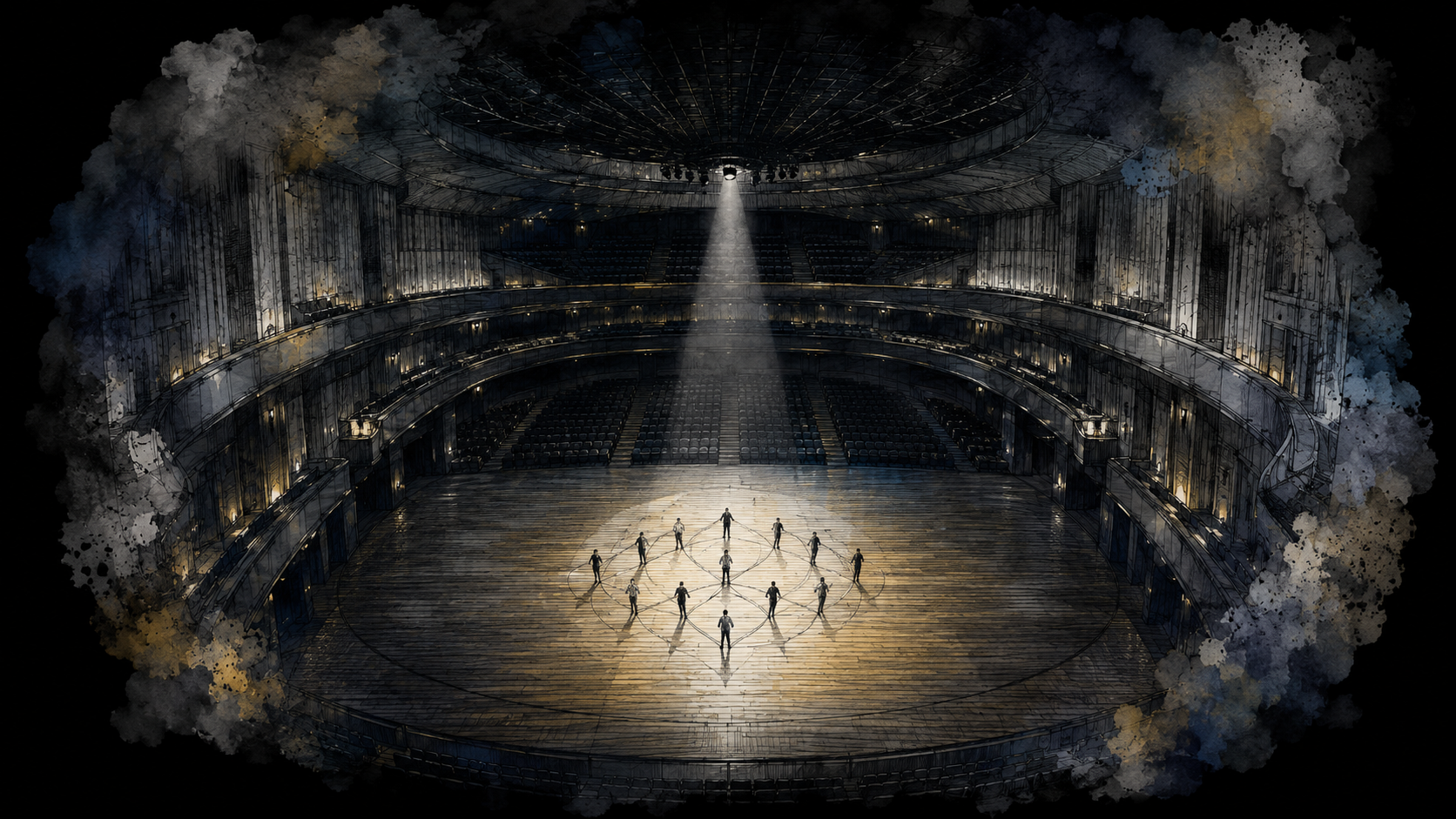 One formation dissolves into the next. Thirteen bodies, one constantly moving picture.
Sometimes the members move together. Sometimes they divide into units. Sometimes one member stands still while the others move around him. Sometimes the formation becomes a clock, a wave, a wall, or a stage inside the stage.
The size of the group allows them to create images that smaller groups cannot easily reproduce. But size alone is not enough. Thirteen uncoordinated performers would only create noise.
SEVENTEEN’s achievement was building a system in which every person knew both his own role and the shape of the complete picture.
Hoshi became central to that process. Professional choreographers also worked with the group, and the members refined performances together. Once again, “self-producing” did not mean “doing everything without help.” It meant being actively involved in the work — and taking responsibility for the final result.
🏟️ From Theaters to World Tours
By 2017, SEVENTEEN had enough international demand to launch the Diamond Edge world tour. They later expanded further with concerts across Asia, North America, and other regions.
This growth is important because Ode to You, which began in 2019, is sometimes incorrectly described as SEVENTEEN’s first world tour. It was not. The group had already toured internationally.
What Ode to You represented was scale. The venues were larger. The audience was broader. The performances carried several years of music rather than the limited catalog of a rookie group.
SEVENTEEN was no longer proving that thirteen members could survive. They were proving that thirteen members could fill arenas.
🖤 An Ode: The End of the First Chapter
In September 2019, SEVENTEEN released their third full-length album, An Ode. The album was darker than much of their earlier work.
“Fear,” its lead single, explored a relationship in which the speaker sees himself as something poisonous. The performance was controlled, dramatic, and almost uncomfortable. It was a long way from the sofa choreography of “Pretty U.”
The album sold 700,863 copies in its first week on Hanteo Chart, setting a new record for SEVENTEEN at the time. Billboard’s critics later selected An Ode as their number-one K-pop album of 2019. In November, the album won Album of the Year at the 2019 Asia Artist Awards.
This was SEVENTEEN’s first grand prize, or daesang.
That detail needs one important explanation. It was their first daesang at the Asia Artist Awards. It was not their first MAMA daesang. That would come four years later, in 2023.
The distinction matters because the two victories represent different stages of the group’s journey. The 2019 award proved that SEVENTEEN had reached the top level. The 2023 award would show how much further they could still climb.
🌍 Ode to You — And the Tour That Could Not Finish
SEVENTEEN began the large-scale Ode to You world tour in 2019. The concerts took the group through major cities in Asia and North America, with additional dates planned for 2020.
Then the world stopped.
As COVID-19 spread, the remaining European dates and some Asian performances were canceled. For a group built around live performance, this was a serious disruption. SEVENTEEN had spent years making their stages bigger. Suddenly, there was no audience in front of them.
But the creative system did not stop working. The group continued releasing music. Their online content became more important. Their self-produced variety show, GOING SEVENTEEN, began reaching viewers who did not necessarily know the songs yet.
The concert doors had closed. Another door was opening.
That is where Part 3 begins.
📈 SEVENTEEN’s First Five Years
| Year | Album or Song | Milestone |
|---|---|---|
| 2015 | 17 Carat | Billboard World Albums longevity and year-end critical recognition |
| 2015–2016 | 17 Carat / Boys Be | Won major rookie awards |
| 2016 | “Pretty U” | First music-show win |
| 2016 | “VERY NICE” | Became a long-running signature song and concert ritual |
| 2017 | “Don’t Wanna Cry” | MAMA Best Dance Performance Male Group |
| 2018 | “Oh My!” | Second consecutive win in the same MAMA category |
| 2019 | An Ode | 700,863 first-week sales and AAA Album of the Year daesang |
| 2019–2020 | Ode to You | Large-scale world tour, later interrupted by COVID-19 |
💭 The Editor’s Pick: “VERY NICE”
A personal note from the Editor.
“VERY NICE” is not the most complex song in SEVENTEEN’s catalog. It may not be the most emotional either. But it may be the song that explains them best.
It begins with excitement. It keeps getting bigger. Everyone joins in. The ending arrives — and then the group refuses to let the moment finish.
That is how SEVENTEEN feels at their best.
The performance is carefully designed, but the joy never feels mechanical. Thirteen people follow an exact system while somehow making the whole thing look like a spontaneous celebration.
It is discipline disguised as chaos. And it is very, very SEVENTEEN.
🔗 Continue the Story
- 👉 Part 1 — Thirteen Strangers, One Vision — How the thirteen members were discovered and brought together
- 👉 Part 3 — Going Global — Million-selling albums, GOING SEVENTEEN, world tours, and the year everything exploded
- 👉 Part 4 — The Empire of Seventeen — Stadiums, UNESCO, military service, and SEVENTEEN after ten years