One Fine Spring Day: The Korean Classic That Defines Heartbreak
Meet One Fine Spring Day (Bomnaleun Ganda), the 2001 Korean classic about love, seasons, and heartbreak. A spoiler-free introduction to one of Korea's most beloved films.
A personal note from the Editor.
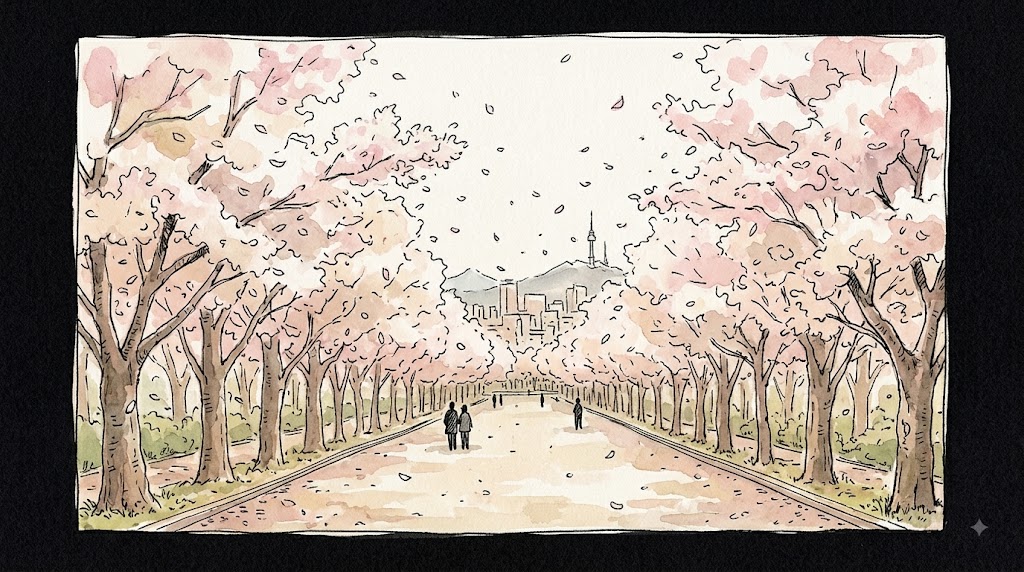
Of all the older Korean films I have covered on this blog, this one might be my personal favorite. One Fine Spring Day, known in Korean as “봄날은 간다,” is a quiet, gentle film that somehow captures the entire arc of a relationship, from its first spark to its final fade, without ever raising its voice. It shows how love between two people changes, right alongside the changing seasons. Maybe it is a familiar kind of story, but I think it is one that lands, deeply, for anyone who has ever truly been in love. I still find myself going back to watch its most famous scenes now and then, and putting on the OST to sit with the memory of it. That soundtrack has become a classic in its own right, still loved by listeners decades later. More than twenty years after its release, Koreans still quote its most famous line in everyday conversation. Today, we start a three-part series on this film, beginning with a spoiler-free introduction.
The Story (No Spoilers, Promise)
Sang-woo is a young sound engineer living in Seoul with his father, aunt, and grandmother. One winter, he travels to Gangneung for a job recording natural sounds for a radio program, where he meets Eun-su, an announcer and producer at a local radio station who is slightly older than him and has been divorced once.
Working together on these recordings, wind through a bamboo grove, a temple bell, waves breaking along the shore, they grow close over the winter. As winter gives way to spring and then summer, their relationship deepens and gradually becomes more complicated than either of them expected.
That is all we will say about the plot here. This is a film best experienced without knowing where it goes, and much of its power comes from watching two people fall in and out of step with each other in real time.
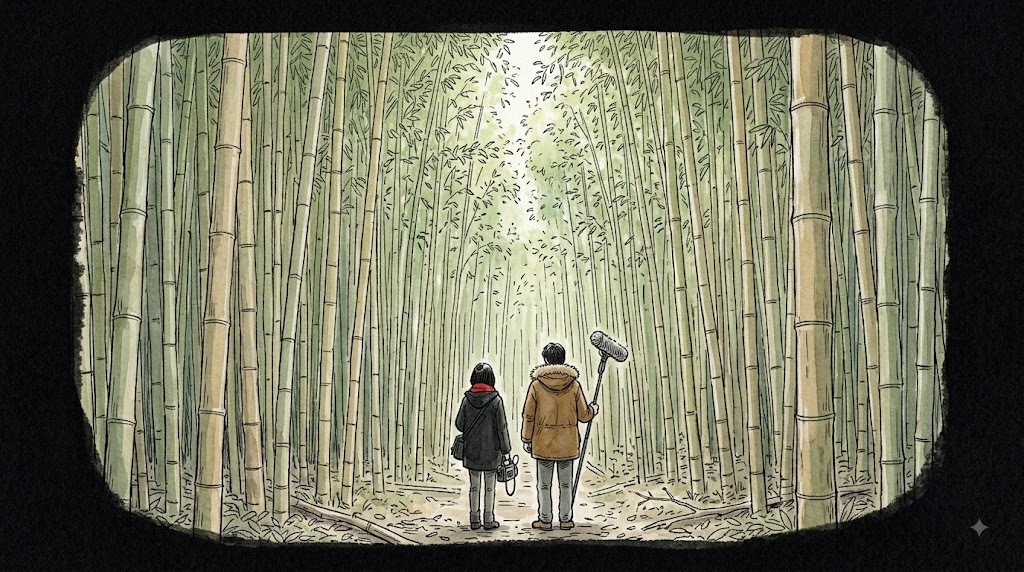 Where their story begins, one winter: two microphones, one bamboo grove, and the sound of the wind.
What the Korean Title Really Means
The English title, “One Fine Spring Day,” is pleasant enough, but it does not quite carry what the original Korean title is doing. Translated literally, “봄날은 간다” means something closer to “the spring day goes,” or “the spring day passes.”
In Korean, “봄날,” spring day, is often used to mean more than just a season. It stands in for those bright, hopeful, love-struck days, the part of a relationship when everything still feels exciting and full of possibility. The second half, “간다,” simply means “goes” or “passes by.” Put together, the title is not really about spring as a season at all. It is about the fact that those golden, spring-like days of a relationship, however wonderful they felt at the time, eventually pass and become the past. That quiet sense of loss, of something precious slipping away no matter how much you want to hold onto it, is baked directly into the Korean title in a way the English one simply cannot capture.
Why This Film Still Matters
One Fine Spring Day comes from director Hur Jin-ho, who had already earned acclaim with his debut film, Christmas in August, another quiet, deeply felt Korean melodrama. With this film, Hur continued to build his reputation as one of Korean cinema’s most patient, emotionally precise storytellers, someone who trusts silence and small gestures as much as dialogue. Where many romance films lean on big, dramatic turning points, Hur lets his characters’ feelings show through a glance, a pause, or the way someone chooses not to answer a question.
The film pairs Yoo Ji-tae and Lee Young-ae, two of Korean cinema’s most respected actors, in a story that unfolds almost entirely through mood and restraint rather than dramatic plot twists. It has endured as a notable Korean romantic drama of the early 2000s, distinguished by its restrained storytelling and its use of natural sound and seasonal change to express the shifts within a relationship. Watching it now, what remains striking is how thoroughly the film lets nature, changing seasons, ambient sound, and silence carry emotions that other romances might put into dialogue.
Its cultural afterlife is especially visible in its dialogue. Eun-su’s line, “Do you want to eat ramyeon?”, became a widely recognized piece of Korean pop-culture shorthand for a romantic invitation, while “How can love change?” remains one of the film’s most frequently recalled lines, still surfacing in headlines and conversation more than two decades later.
A Quiet Awards Darling
One Fine Spring Day opened theatrically in South Korea on September 28, 2001, and went on to receive significant recognition both at home and abroad. It won Best Film at the 2001 Blue Dragon Film Awards, while director Hur Jin-ho received Best Director at the 2002 Baeksang Arts Awards. Internationally, the film won the Best Artistic Contribution Award in competition at the 2001 Tokyo International Film Festival, and it was also selected for the Tiger Competition at the 2002 International Film Festival Rotterdam.
For a film built almost entirely on quiet, intimate moments rather than spectacle, that kind of recognition, at home and on the international festival circuit alike, says a lot about how universally its story of love and loss translates.
Want a first look?
▶ Search for the One Fine Spring Day Official Trailer on YouTube
Where to Go From Here
If slow, emotionally patient Korean storytelling is your thing, our deep dive on My Mister explores similar territory. And if you want to see where Hur Jin-ho’s style began, keep an eye out for our coverage of his earlier film, Christmas in August.
Editor’s Rating: 9.3 / 10
Coming up next: in Part 2, we go full spoiler mode and talk about the film’s most unforgettable scenes and lines. And in Part 3, we look at the director, the cast, and the music that ties it all together.
— The Editor