When Life Gives You Tangerines: The Scenes That Wrecked Everyone
A full spoiler breakdown of When Life Gives You Tangerines, including the loss of Ae-sun and Gwan-sik's youngest son and Geum-myeong's heartbreaking choice between two very different loves.
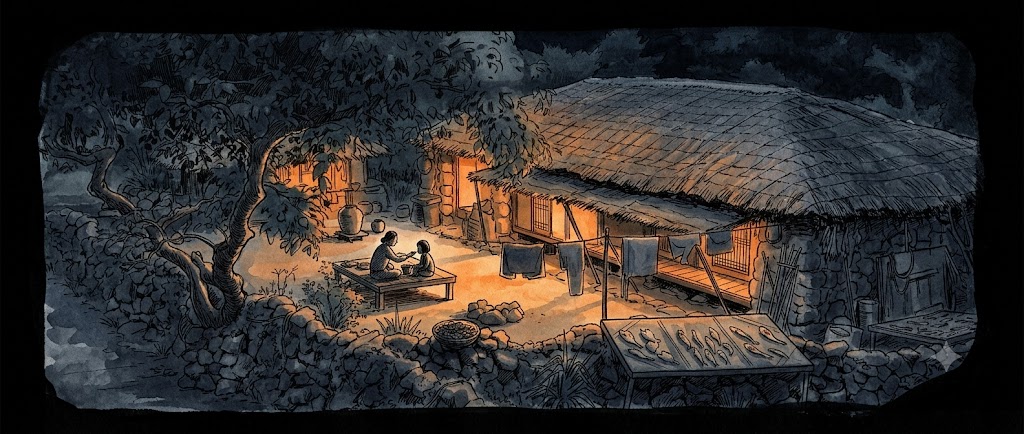
⚠️ Full spoilers. This post covers major plot points from When Life Gives You Tangerines, including its ending. If you have not watched it yet, start with our spoiler-free Part 1 guide instead.
A personal note from the Editor.
I promised in Part 1 that this show made me cry. I was not exaggerating. There is one scene in particular I could not get through without tearing up, and I want to walk through it honestly, along with another moment that hit almost as hard: a daughter’s choice between two very different kinds of love.
The Loss of Dong-myeong
Early in the series, Ae-sun and Gwan-sik are already parents to three young children. During a violent typhoon, Ae-sun learns that her daughter, Geum-myeong, has been hurt outside. She rushes out to find her, asking a neighbor to watch her two young sons, five-year-old Eun-myeong and three-year-old Dong-myeong, while she is gone.
During the typhoon, Ae-sun rushes out after hearing that Geum-myeong has been hurt, calling on a neighbor to watch the two boys. But the children do not stay safely inside. Eun-myeong later admits, in tears, that he snuck out to ride his bike despite the storm and left his younger brother alone. Dong-myeong, the youngest, is found alone near the seawall. He drowns.
The show does not rush past this. Ae-sun is shown cradling her son’s body, begging neighbors for an ambulance that will not save him. Gwan-sik, normally the quiet, steady one in the relationship, completely breaks down, sobbing uncontrollably at his son’s side. The family is given only three days to mourn before Gwan-sik forces himself back to work at sea, trying to keep the surviving family moving forward.
I am a parent myself, and I could not sit through this scene without crying. It is one thing to intellectually understand that losing a child is the worst kind of grief a person can go through. It is another thing entirely to watch two ordinary, loving parents fall apart in real time, and to watch their surviving children quietly blame themselves for something that was never their fault. The show does not use this moment for cheap shock value. It sits with the weight of it, and it does not let Ae-sun and Gwan-sik heal quickly or neatly. Ae-sun grows bitter toward the sea that took her son. Gwan-sik tells her that no one in their family is to blame, that they have to keep living for the children they still have. That is not a resolution. It is just what surviving looks like.
Decades later, in the show’s final episodes, Ae-sun and Gwan-sik finally sit together at Dong-myeong’s grave and talk about him properly, for what may be the first time since losing him. The show suggests that some grief simply cannot be rushed. You carry it until you are ready to set it down for a moment, even if that moment takes thirty years to arrive.
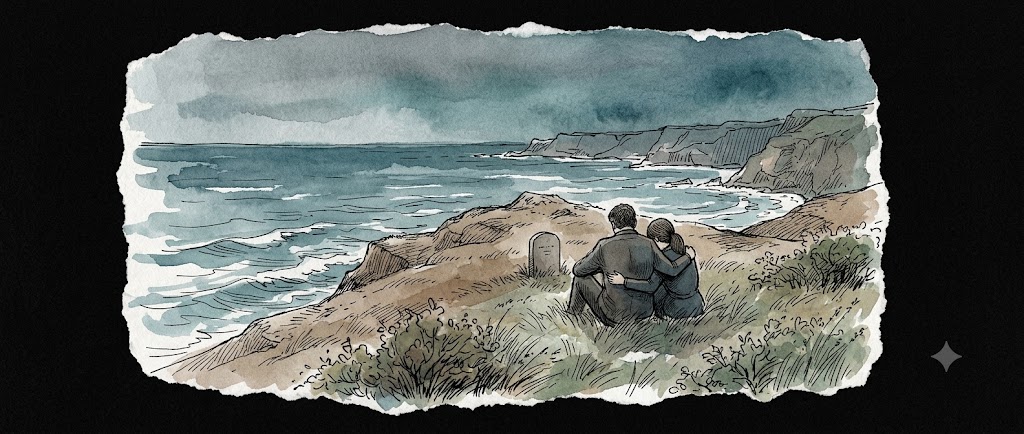 Some grief does not resolve. It just gets carried, together.
Geum-myeong’s Two Loves
Years later, the show shifts much of its focus to Ae-sun and Gwan-sik’s daughter, Geum-myeong, now grown and living in Seoul. She spends seven years in a relationship with a college boyfriend named Yeong-bum. It seems steady, even destined, until his mother enters the picture.
Yeong-bum’s mother looks down on Geum-myeong for coming from a working-class, small-town family, and treats her with open disrespect. Geum-myeong is willing to put up with a lot for love, but the breaking point comes when she realizes how much this treatment hurts her own parents, the same parents who sacrificed everything, including Ae-sun’s own dream of opening a store, just to give her a chance at a better life. Yeong-bum even offers to cut ties with his mother entirely, but Geum-myeong refuses to let him make that sacrifice. She fears that building a marriage on that kind of rift would only breed resentment between them later. Rather than let things continue, Geum-myeong makes the painful decision to end the relationship herself. He later marries another woman, but a much later scene reveals that he still deeply resents his mother for interfering in his life and for the choice that cost him Geum-myeong.
Some time later, Geum-myeong reconnects with Park Chung-seob, an aspiring artist she had actually met years earlier, back when he gave her a part-time job at the movie theater where he painted posters. He had feelings for her even then, but she was devoted to Yeong-bum at the time. After Geum-myeong’s breakup and Chung-seob’s return from military service, he tracks her down again, quite literally chasing down a bus to reach her. They fall in love, and eventually marry.
What makes this pairing land so well is how directly the show has Geum-myeong explain the difference between the two relationships herself. In her wedding-day voiceover, she says the size of her love for each man was not different, but the temperature was. With Chung-seob, it was a warmth that let her be herself, without needing to shrink or apologize for where she came from. Yeong-bum’s family made her feel small. Chung-seob’s presence made her feel like her full self was enough.
Why These Two Moments Belong Together
On the surface, a child’s death and a daughter’s breakup look like very different kinds of pain. But the show quietly connects them. Both moments are about what a family is willing to carry, and what it refuses to carry any longer.
Ae-sun and Gwan-sik absorb an unimaginable loss and keep moving forward for the children they have left. Geum-myeong, raised by two people who gave up so much of themselves for her, ultimately refuses to stay somewhere she is made to feel less than what she is. In a strange way, her ability to walk away from Yeong-bum is only possible because of everything her parents modeled for her: love should not require you to disappear.
Where to Go From Here
If stories about the quiet, generational cost of love and sacrifice speak to you, our deep dive on My Mister, from the same director, explores similar emotional ground. And if you have not yet read our spoiler-free introduction, Part 1 is a good place to start.
Editor’s Rating: 9.2 / 10
Want to know more about the people who made this show? Director Kim Won-seok, writer Lim Sang-choon, and the full cast are profiled in Part 1.
— The Editor